

INSIGHT
The at-fault driver’s insurance company usually does not pay an injured person’s medical bills one at a time as treatment occurs.
The liability carrier generally investigates the entire bodily-injury claim and resolves it through a settlement or judgment later. Meanwhile, the providers that supplied treatment may still expect payment. Medical payments coverage, health insurance, workers’ compensation, provider arrangements, or the patient may therefore address bills before the liability claim is resolved.
Understanding that sequence can prevent an avoidable problem: allowing medical bills to enter collections while everyone waits for an at-fault carrier that was never planning to pay them directly as they arrived.
Why does the at-fault carrier not simply pay each provider?
A liability insurer is evaluating the claim made against its insured. It may investigate fault, causation, the reasonableness and relationship of treatment, the nature of the injuries, prior medical history, damages, and available policy limits.
The carrier ordinarily wants to resolve the bodily-injury claim as a whole. That resolution may account for past medical expenses along with future care, lost income, impairment, disfigurement, pain, and other legally recoverable losses.
Medical providers operate on a different timeline. They may send bills, request insurance information, or begin collection efforts while the liability carrier is still investigating.
Colorado MedPay may provide an early source of payment
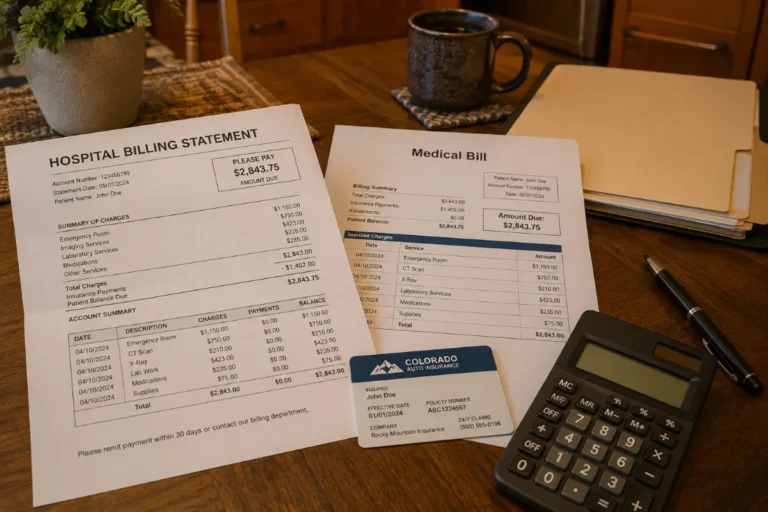
Medical payments coverage, commonly called MedPay, is first-party automobile insurance that pays qualifying accident-related medical expenses without requiring the insured to establish that another driver was at fault.
Subject to statutory exceptions, Colorado automobile liability policies generally include $5,000 in MedPay coverage unless the named insured rejected it in writing or through the same medium used for the application. The insurer must retain proof of the rejection. C.R.S. § 10-4-635(1).
The exact policy determines who qualifies as an insured and which expenses are covered. Depending on the circumstances, that may include the named insured, resident relatives, permissive occupants, or others protected by the policy.
MedPay can help address emergency care, medical appointments, imaging, therapy, prescriptions, deductibles, copayments, and other covered expenses. It has a policy limit, however, and that limit can be exhausted before the injury claim is resolved.
Colorado law generally coordinates MedPay as primary to health insurance for covered accident-related medical expenses. That can make the order in which providers submit bills important. C.R.S. §§ 10-4-636 and 10-4-641.
Health insurance should not be ignored
An injured person should ordinarily provide health-insurance information to medical providers even when another driver caused the crash.
Using health insurance does not relieve the responsible driver of liability. It may reduce the amount providers immediately demand, apply negotiated rates, and prevent unnecessary collection problems while the bodily-injury claim remains pending.
A provider may sometimes decline to submit the bill because the treatment followed an automobile crash. Ask the provider to explain that position and, when appropriate, request submission in writing. There may be a coding problem, missing MedPay information, an out-of-network issue, or a misunderstanding about which carrier is expected to pay first.
Health insurers and benefit plans may later assert reimbursement or subrogation rights against a personal injury recovery. The validity and amount of that claim can depend on the plan, governing law, payments made, and the terms of the coverage. It should be identified before the injury claim is settled and the proceeds distributed.
A bill is not always the same as the amount owed
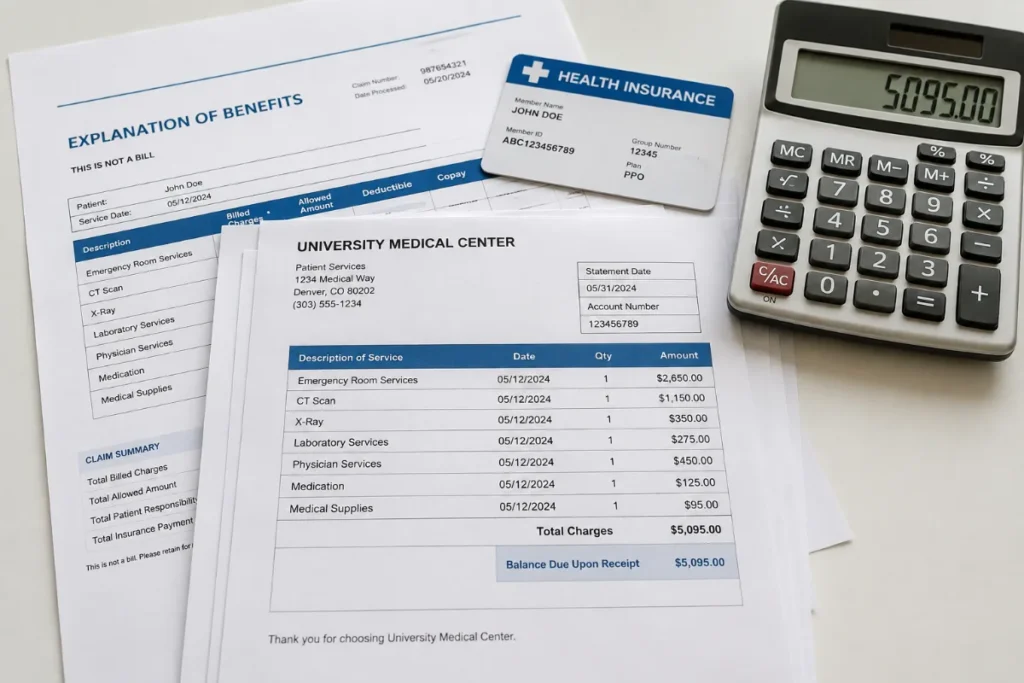
A medical account can contain several different numbers: the provider’s billed charge, the amount allowed by insurance, the amount insurance paid, contractual adjustments, patient responsibility, and the current balance.
Those numbers should not be collapsed into one figure without understanding the account. An explanation of benefits is not necessarily a bill, and a balance shown on a provider portal may not reflect a recent insurance payment.
Request itemized bills and updated payment histories. Keep the associated explanations of benefits so the amounts can be reconciled.
Provider liens and deferred-payment agreements
Some providers agree to delay collection in exchange for an asserted right to payment from a later settlement. These arrangements are often described as treatment on a lien.
A lien arrangement may allow treatment to continue when no immediate payment source is available, but it is not free medical care. Before signing, understand the rates, whether health insurance could be used, whether interest or fees apply, what happens if the claim does not produce a recovery, and whether the provider may still pursue the patient personally.
Not every document labeled a lien has the same legal effect. The document itself matters.
Workers’ compensation may apply to a work-related crash
When the collision occurred in the course and scope of employment, workers’ compensation may provide medical and wage benefits regardless of whether another driver was at fault.
The injured employee may also have a claim against the responsible third party. The workers’ compensation carrier may assert reimbursement rights against that recovery, making coordination between the claims important.
UM/UIM coverage may address an insurance shortfall
When the responsible driver has no bodily-injury insurance or not enough insurance to cover the loss, uninsured or underinsured motorist coverage may apply.
UM/UIM is not a substitute for MedPay or health insurance while treatment occurs. It is part of the broader bodily-injury recovery and ordinarily requires proof of fault, causation, damages, insured status, and available coverage.
The coverage investigation should occur before the claim against the responsible driver is finally released. See Colorado UM/UIM Claims: What Happens When the At-Fault Driver Has No Insurance or Not Enough?.
Keep a complete medical-expense file
- Itemized medical bills and current provider balances;
- Health-insurance explanations of benefits;
- MedPay payment records and coverage correspondence;
- Prescription, medical-equipment, and transportation receipts;
- Collection notices and denial letters;
- Provider lien or deferred-payment agreements;
- Medicare, Medicaid, workers’ compensation, or health-plan reimbursement correspondence; and
- Records showing which amounts were billed, adjusted, paid, or remain outstanding.
Do not assume that a provider, insurer, or law office has received a bill simply because another person was supposed to send it. Confirm receipt of significant documents.
What happens when the claim settles?
Before settlement funds are distributed, the accounting should identify outstanding providers, valid liens, health-plan reimbursement claims, Medicare or Medicaid interests, workers’ compensation payments, attorney fees, case expenses, and any future medical needs addressed by the settlement.
A settlement that appears adequate before those obligations are identified can produce a very different result afterward. The client should be able to understand what came into the case, what must be paid, and why.
Rex Legal represents people injured in Colorado crashes and handles related MedPay, UM/UIM, and first-party insurance disputes. The goal is not merely to collect bills. It is to understand how each account was handled and how the medical-payment system affects the client’s actual recovery.
Tell Us What Happened.
Michael Rex can review what happened and what should occur next. Available 24 hours a day, 7 days a week.
This article is general information about Colorado law, not legal advice, and does not create an attorney-client relationship. Every case turns on its own facts.