

INSIGHT
The first minutes after a car crash are disorienting. The days that follow can be nearly as difficult. Vehicles need attention, insurers begin calling, medical symptoms may change, and evidence can disappear before anyone realizes it will matter.
The immediate priorities are safety, appropriate medical care, and an accurate record of what happened. The legal and insurance issues can be addressed afterward, but some of the evidence needed to address them must be preserved at the scene or shortly thereafter.
Begin with safety
Move out of an active traffic lane when it is safe and lawful to do so. Use hazard lights, watch for leaking fluids or fire, and avoid standing between damaged vehicles or near moving traffic.
Call 911 when anyone may be injured, a vehicle creates a roadway hazard, a driver appears impaired, a driver attempts to leave, or the parties need law enforcement assistance. Do not move a person who may have a serious head, neck, or spinal injury unless remaining in place creates a greater immediate danger.
Colorado law generally requires a driver involved in a qualifying crash to stop and remain at the scene, provide identifying and vehicle information, exhibit a driver’s license when requested, and render reasonable assistance to an injured person. Crashes involving injury, death, or property damage also carry duties and reporting requirements under C.R.S. §§ 42-4-1601, 42-4-1602, 42-4-1603, and 42-4-1606.
Exchange information without arguing about fault
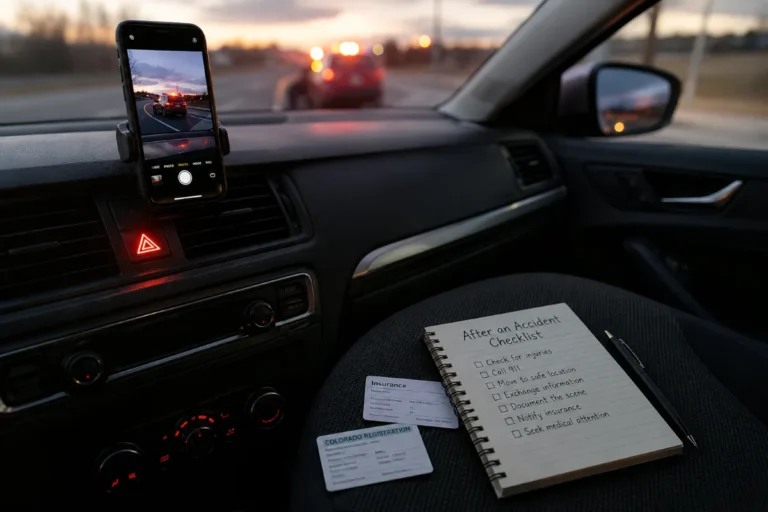
Obtain the other driver’s name, contact information, driver’s license, registration, license plate, insurance company, and policy number. When the driver does not own the vehicle, identify the registered owner. When the driver was working, delivering goods, transporting a passenger, or operating a commercial vehicle, obtain the employer or platform information as well.
Do not use the roadside exchange to litigate the case. Avoid arguments, accusations, or guesses about who violated which law. Give law enforcement a truthful description of what you personally observed, but distinguish a clear memory from an estimate or assumption.
It is appropriate to say, “I do not know,” when that is the accurate answer.
Document more than the vehicle damage
Photographs of the vehicles matter, but they do not always explain how the collision occurred. A useful set of images establishes the location, roadway geometry, traffic controls, visibility, and final positions in addition to showing close views of the damage.
- Photograph all sides of every involved vehicle, including close and wide views of each impact area.
- Photograph the vehicles’ resting positions, debris, fluids, skid marks, lane markings, traffic signals, signs, and roadway approaches.
- Record weather, lighting, construction, snow, ice, sight obstructions, and any temporary traffic control.
- Obtain each witness’s name, telephone number, and email address.
- Identify nearby businesses, homes, buses, parking facilities, and vehicles that may have recorded the collision.
- Preserve the original image and video files without filters, annotations, or destructive editing.
A neutral witness or short piece of video may become especially important when the drivers later disagree about the signal, right of way, lane position, speed, or movement before impact. Surveillance footage is often overwritten quickly, so the location and time of any potential recording should be documented immediately.
Obtain the report information
Ask the responding agency for the incident or report number and instructions for obtaining the report.
A police report can organize identifying information and preserve early statements, but it is not necessarily the final determination of civil fault. Officers often arrive after the collision and reconstruct what occurred through statements, physical evidence, and their observations.
When an officer does not investigate the scene, determine whether the crash should be reported through the Colorado State Patrol’s reporting process.
Seek appropriate medical care
Some injuries are immediately obvious. Others become clearer after the initial stress response subsides.
Headache, dizziness, confusion, memory difficulty, neck or back pain, numbness, weakness, vision changes, joint instability, sleep disruption, and unusual emotional or cognitive changes deserve accurate reporting and appropriate medical evaluation. Severe or worsening symptoms may require emergency care.
Tell medical providers how the crash occurred, whether the head or body struck anything, when symptoms began, and how those symptoms are affecting ordinary function. Disclose relevant prior conditions honestly. A prior injury does not automatically eliminate a new claim, but inaccurate medical history can create avoidable credibility and causation issues.
Do not exaggerate symptoms. Do not minimize them out of habit, embarrassment, or concern about inconveniencing someone.
Report the crash to your insurer
Most automobile policies require reasonably prompt notice of a collision or potential claim. Give your carrier the basic facts needed to open the claim and obtain the claim number and adjuster’s contact information.
Ask which coverages may apply. Depending on the policy and circumstances, those may include collision coverage, rental reimbursement, medical payments coverage, and uninsured or underinsured motorist coverage.
Reporting the claim is not necessarily the same as agreeing to an immediate recorded statement. A request from your own insurer also raises different obligations than a request from the other driver’s liability carrier. That distinction is addressed in Should I Give an Insurance Adjuster a Recorded Statement After a Colorado Crash?.
Preserve the vehicle and physical evidence
Before a severely damaged vehicle is salvaged, destroyed, or materially repaired, determine whether it should be inspected or its data preserved.
The vehicle may contain evidence concerning impact direction, airbag deployment, seat-belt use, event data, tire condition, or a mechanical failure. Helmets, child safety seats, bicycles, damaged components, clothing, and personal electronic devices may also matter.
Necessary safety measures and ordinary repairs should not be delayed without reason. The point is to create a complete photographic and documentary record before the condition changes.
Keep one organized claim file
Save the report, photographs, witness information, medical bills, explanations of benefits, repair documents, rental records, insurance communications, wage records, and significant out-of-pocket expenses in one place.
After an important telephone conversation, make a brief dated note identifying who participated, what was discussed, and what each person agreed to do. The note should record the conversation, not improve it.
A concise symptom-and-function journal may also help preserve information that would otherwise be forgotten. It should identify meaningful changes, work problems, appointments, and limitations without becoming a theatrical hourly catalogue of every sensation.
Be cautious with releases and social media
A bodily-injury release ordinarily ends the claim against the parties and claims it covers. Before signing one, understand the injuries, expected future care, available insurance, outstanding medical obligations, wage loss, and the full scope of the release.
Social media creates a different problem. A photograph taken during a brief outing may be separated from its context and portrayed as proof that an injury is insignificant. Do not destroy existing posts after a dispute arises. Preserve relevant material, review privacy settings, and avoid using social media as a running commentary on the crash or claim.
Colorado can divide fault
Colorado follows a modified comparative-negligence system. A claimant’s damages may be reduced by the percentage of fault assigned to the claimant, and recovery may be barred when the claimant’s negligence is equal to or greater than the opposing negligence. C.R.S. § 13-21-111.
That is another reason early evidence matters. An adjuster’s initial impression of fault is not binding, but photographs, witnesses, video, and early statements can substantially affect the eventual allocation.
When should a lawyer review the crash?
Legal review becomes particularly important when the injuries are serious, a brain injury is suspected, fault is disputed, several vehicles are involved, the responsible vehicle was commercial or governmental, the driver left the scene, insurance limits may be inadequate, or evidence is at risk of destruction.
Rex Legal represents people injured in Colorado motor-vehicle crashes, including claims involving traumatic brain injuries, motorcycles, commercial vehicles, rideshare companies, and uninsured or underinsured drivers.
Tell Us What Happened.
Michael Rex can review what happened and what should occur next. Available 24 hours a day, 7 days a week.
This article is general information about Colorado law, not legal advice, and does not create an attorney-client relationship. Every case turns on its own facts.