

BICYCLE & PEDESTRIAN INJURY CLAIMS
Denver Bicycle & Pedestrian Accident Lawyer
In a bicycle or pedestrian crash, the first account is often the least complete.
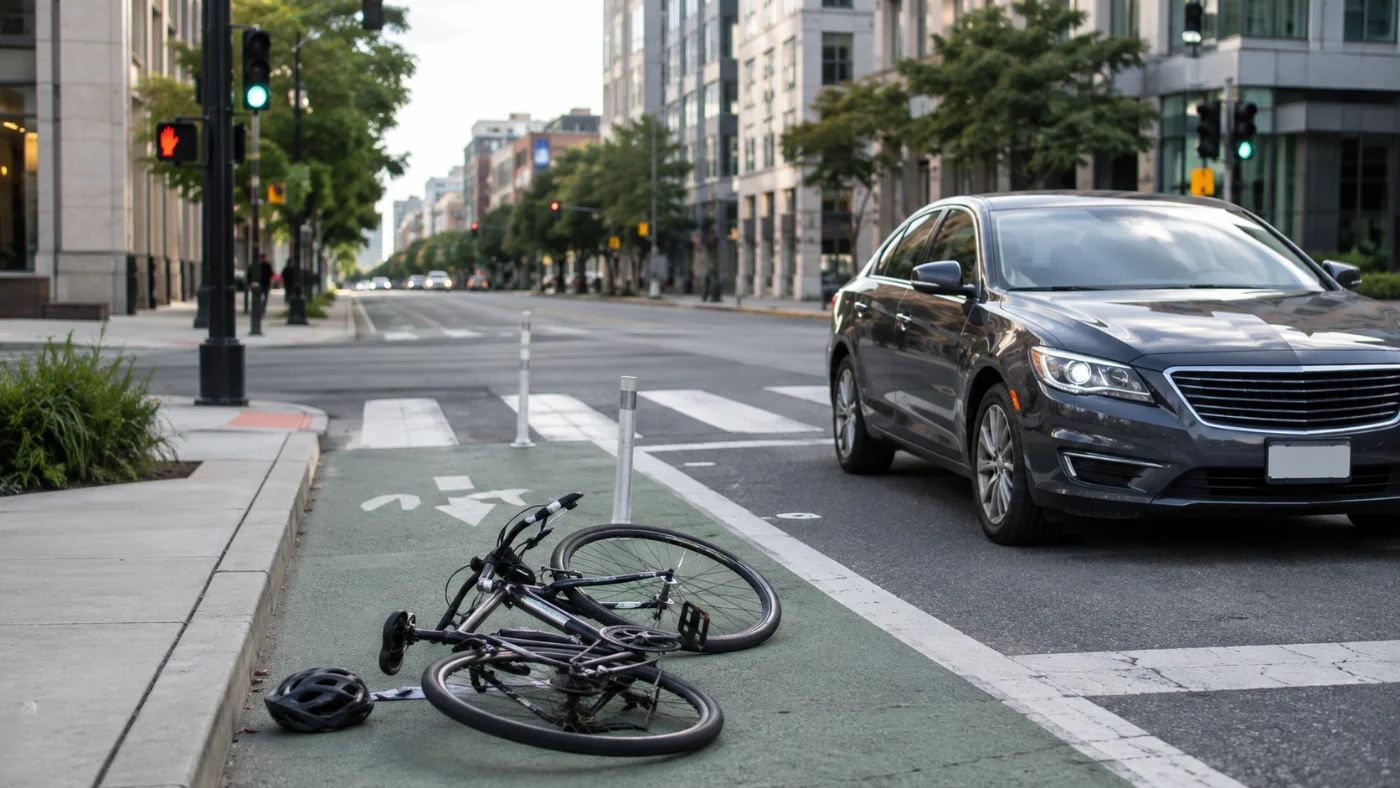
The driver may be standing beside the vehicle speaking with the officer. The cyclist may be in an ambulance. The pedestrian may be unconscious, medicated, or unable to explain what happened. By the time the injured person can give an account, the driver’s version may already appear in the crash report.
“The cyclist came out of nowhere” and “the pedestrian darted into traffic” are not findings of fact. They are claims to be tested against the roadway, the traffic rules, the physical evidence, and the time the driver had to see what was ahead.
Test the Driver’s Account.
Fault begins with what each person was doing before impact. Where was the bicycle or pedestrian? Where was the vehicle? Who had the right of way? How fast was the driver traveling? What could the driver see? Was the cyclist in a traffic lane, bike lane, shoulder, sidewalk, or crosswalk? Was the pedestrian crossing at an intersection or somewhere else?
Physical evidence can answer questions the first police interview cannot. Vehicle damage, bicycle damage, debris, photographs, surveillance, electronic vehicle data, sight lines, traffic-signal timing, witness accounts, and the final resting positions of the people and vehicles can test competing descriptions of the collision.
Colorado’s modified comparative-negligence rule also applies when the evidence supports fault by the injured person. Under C.R.S. § 13-21-111, negligence attributable to the claimant can reduce recovery and can bar it when that negligence is as great as or greater than the negligence against which recovery is sought. The analysis begins with conduct, not with the assumption that the larger vehicle must be right because its driver was able to tell the story first.
Apply the Street Rules.
Cyclists Have Specific Rights.
Colorado requires a motorist overtaking a bicyclist traveling in the same direction to maintain at least three feet of separation, measured from the vehicle including its mirrors and other projections. Colorado also prohibits a motorist from carelessly driving unnecessarily close to, toward, or near a bicyclist. A narrow Denver street does not eliminate the passing requirement; if the pass cannot be made safely, the driver has to wait.
Colorado’s Safety Stop law also matters, because it is frequently misstated after a crash. Under C.R.S. § 42-4-1412.5, a cyclist who is at least fifteen years old, or a younger cyclist accompanied by an adult, may treat a stop sign as a yield under the statutory conditions. The rider must slow to ten miles per hour or less unless a properly posted local rule permits a higher speed, yield to traffic and pedestrians in or approaching the intersection, and stop when safety requires it.
A red light is different. The qualifying rider must first stop and yield to all other traffic and pedestrians. The rider may then cautiously proceed straight or turn right when the statutory conditions permit; a left turn on red is permitted only onto a one-way street and subject to additional conditions. The Safety Stop is not permission to ride through an intersection without yielding.
Dooring has its own rule. Colorado prohibits opening a motor-vehicle door on the side available to moving traffic unless it is reasonably safe and can be done without interfering with that traffic. A collision with an opened door therefore requires examination of where the cyclist was riding, when the door moved, what the occupant could see, and whether there was time to avoid it.
Pedestrians Have Their Own Rules.
Colorado recognizes both marked crosswalks and unmarked crosswalks at intersections. When traffic signals are absent or not operating, C.R.S. § 42-4-802 requires a driver to yield to a pedestrian in a crosswalk when the pedestrian is on the driver’s half of the roadway or approaching closely enough from the other half to be in danger. A pedestrian may not suddenly leave a curb or other place of safety and enter the path of a vehicle that is so close as to create an immediate hazard.
Outside a marked crosswalk or an unmarked crosswalk at an intersection, the pedestrian generally must yield to vehicles under C.R.S. § 42-4-803. Drivers nevertheless retain a separate duty under § 42-4-807 to exercise due care to avoid colliding with pedestrians and to take proper precaution upon observing a child or an obviously confused or incapacitated person. Those rules matter when an insurer reduces a pedestrian collision to the phrase “not in a crosswalk.”
Children, older pedestrians, and people using mobility devices also cannot be analyzed as interchangeable adults moving at the same speed. Age, mobility, visibility, walking speed, reaction time, and what the driver actually observed can all become part of the factual analysis.
Recover What Disappears.
A bicycle or pedestrian case can have less physical evidence than a two-car collision. There may be no second vehicle with a crush pattern to compare. The bicycle may be removed from the scene. Clothing and a helmet may be discarded. The driver’s windshield, mirror, or bodywork may be repaired before anyone documents it.
Video can be especially important in Denver intersections and commercial corridors. Traffic cameras, apartment buildings, storefronts, buses, doorbell cameras, and nearby vehicles may have recorded the seconds before impact. That footage is often overwritten. Witnesses leave. Lighting conditions change. Construction moves. Vegetation is trimmed. Snow melts.
If the injured person could not give an account at the scene, recovering those independent sources can change the entire record. Early investigation is not about creating a better story. It is about finding the evidence that shows which story is true.
Search for Other Coverage.
The driver’s liability policy is only one place to look. A bicycle rider or pedestrian struck by an uninsured, underinsured, or unidentified motorist may also have uninsured or underinsured motorist coverage through an automobile policy under which that person qualifies as an insured, even though the injured person was not occupying a car.
That surprises most people. Riding a bicycle or walking does not by itself make automobile UM coverage irrelevant, and Colorado law has long recognized claims by insured people struck while outside an insured vehicle. Coverage remains policy-specific, so the actual policy and insured relationships have to be reviewed.
Hit-and-run cases make the point particularly important. Where a driver is never identified, uninsured motorist coverage can become the only realistic source of recovery. Whether a particular cyclist or pedestrian qualifies as an insured still depends on the policy and the circumstances.
Auto Insurance and UM/UIM Claims addresses those issues separately and may provide an injured person with additional insurance coverage.
Correct the Early Record.
A crash report written before the cyclist or pedestrian can speak can make one person’s account look settled when it is not. Police officers investigate traffic collisions; they do not necessarily witness them. The report should be compared with photographs, video, physical evidence, witness accounts, roadway measurements, and the applicable traffic rules.
Recorded statements create a similar problem. Someone recovering from surgery, concussion, medication, shock, or significant pain may be asked to estimate distance, speed, timing, or exactly where they entered a roadway. Later differences can be used to challenge liability or credibility.
Whether a statement must be given depends on who is asking and what contractual obligations apply. The important point is that an early account is evidence. It should not be treated as casual conversation simply because an adjuster asks for it quickly.
Use the Motor-Vehicle Clock.
A cyclist or pedestrian struck by a motor vehicle is not limited to Colorado’s ordinary two-year tort period merely because the injured person was outside the vehicle. C.R.S. § 13-80-101(1)(n) provides a three-year period for tort actions for bodily injury or property damage arising from the use or operation of a motor vehicle. That language focuses on the source of the injury, not on whether the claimant was riding inside the motor vehicle.
Not every bicycle or pedestrian claim is a motor-vehicle claim. An injury caused by unsafe property, a defective bicycle component, or another non-motor-vehicle condition can implicate a different limitations period. Claims involving a public entity can also carry separate notice requirements. The correct deadline follows the legal claim, not the label.
Measure the Physical Loss.
A person on a bicycle or on foot has no passenger compartment between the body and the vehicle, pavement, or surrounding objects. The resulting injuries can involve several medical systems at once.
Traumatic brain injury deserves its own analysis. A traumatic brain injury may involve memory, concentration, processing speed, balance, behavior, or other neurological changes even when conventional imaging does not show a dramatic structural injury. A cyclist or pedestrian who cannot remember the collision may also be unable to supply the very account an insurer says is missing.
Spinal cord injury, paralysis, amputation, severe orthopedic damage, and other permanent physical impairment can require the future medical, vocational, and life-care analysis addressed in catastrophic injury claims. Fractures, ligament injuries, scarring, dental and facial trauma, and injuries to the pelvis, knees, shoulders, hands, and feet require their own causation and functional proof.
Michael Rex Tests the Record.
Rex Legal does not treat the driver’s first account or the crash report as the end of the liability investigation. Michael Rex remains directly involved in reconstructing the collision, identifying the governing road rules and insurance, and developing the medical evidence from evaluation through resolution.
Bicycle and Pedestrian Questions.
How much space does a driver have to give a bicyclist in Colorado?
At least three feet when overtaking a bicyclist traveling in the same direction. Colorado measures that separation from the motor vehicle, including its mirrors or other projections, to the cyclist. The rule does not require a cyclist to squeeze into an unsafe edge of the roadway so a vehicle can pass. If the pass cannot be made safely, the driver has to wait.
Can a bicyclist roll through a stop sign in Colorado?
Under limited conditions. C.R.S. § 42-4-1412.5 allows riders who are at least fifteen, and younger riders accompanied by an adult, to treat a stop sign as a yield. The cyclist must slow to ten miles per hour or less unless a properly posted local rule allows more, yield to traffic and pedestrians, and stop if safety requires it. A red traffic signal still requires a complete stop first.
Who has the right of way in a Colorado crosswalk?
It depends on the traffic controls and where the pedestrian is. When signals are absent or not operating, C.R.S. § 42-4-802 requires drivers to yield to qualifying pedestrians in a crosswalk, including when the pedestrian is approaching dangerously close from the opposite half of the roadway. Pedestrians cannot suddenly enter the path of a vehicle creating an immediate hazard, and pedestrians crossing outside marked or unmarked intersection crosswalks generally must yield.
What should I do after a bicycle or pedestrian hit-and-run?
Preserve every available way to identify the vehicle or prove how the collision occurred: photographs, debris, witness information, nearby surveillance, partial plate information, vehicle description, 911 records, and the police report. Uninsured motorist coverage may apply even if the driver is never identified, when the injured person qualifies as an insured under an applicable auto policy.
Can my own auto insurance cover me if I was hit while walking or riding a bicycle?
It may. UM/UIM coverage protects people who qualify as insureds under the policy, and being outside the insured automobile does not necessarily eliminate coverage. The actual policy, the insured relationships, and any written rejection of UM/UIM coverage still have to be reviewed. Auto Insurance and UM/UIM Claims addresses those issues separately and may provide an injured person with additional insurance coverage.
Does not wearing a bicycle helmet hurt my injury claim?
Colorado has no statewide helmet requirement for ordinary bicycle riders, and the absence of a helmet does not establish who caused the collision. Colorado does require helmets for younger riders on class 3 electric bicycles under C.R.S. § 42-4-1412, and that statute provides that violating the helmet requirement does not constitute negligence or negligence per se in a civil personal-injury claim.
How long do I have to file a bicycle or pedestrian accident lawsuit in Colorado?
Many claims arising from being struck by a motor vehicle have a three-year limitations period under C.R.S. § 13-80-101(1)(n), even though the injured person was cycling or walking. Other bicycle or pedestrian claims can have different deadlines because they do not arise from motor-vehicle use or involve special defendants. The correct limitations period depends on what caused the injury and who is responsible.
What if the driver says I suddenly appeared in front of the car?
That assertion has to be tested. Sight lines, driver speed, lighting, crosswalk location, bicycle-lane position, surveillance, witnesses, vehicle damage, electronic data, reaction distance, and the applicable right-of-way rules can show how long the cyclist or pedestrian was visible before impact. A driver’s statement that someone “came out of nowhere” is evidence of the driver’s account. It is not proof that there was no opportunity to see the person.
Tell Us What Happened.
If you were struck while riding a bicycle or walking, Michael Rex can review the roadway rules, the physical evidence, the crash report, and every potentially applicable insurance policy. Available 24 hours a day, 7 days a week.