

INSIGHT
A serious injury does not become less serious because the responsible driver purchased inadequate insurance.
Uninsured and underinsured motorist coverage—usually shortened to UM/UIM—may provide benefits through an insurance policy covering the injured person when the at-fault driver has no bodily-injury insurance, cannot be identified, or lacks enough coverage to compensate the covered damages.
A UM/UIM claim is made under an insurance policy that protects the claimant. It is not automatic. The claimant may still need to establish fault, causation, damages, insured status, and compliance with the applicable policy.
The difference between UM and UIM coverage
Uninsured motorist coverage generally addresses a covered injury caused by a driver who lacks applicable bodily-injury liability insurance. Depending on the facts and policy, it may also apply to a hit-and-run or qualifying unidentified-driver claim.
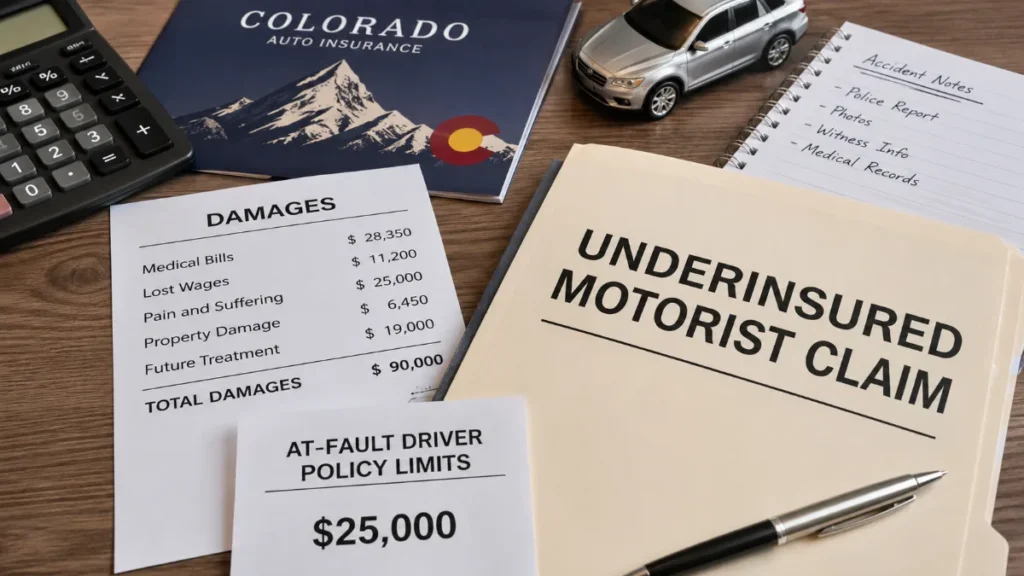
Underinsured motorist coverage generally addresses the shortfall created when the responsible driver has insurance, but the available liability limits are insufficient to compensate the covered damages.
For example, a driver may carry liability coverage but cause an injury involving surgery, permanent impairment, extensive rehabilitation, lost earning capacity, or future medical care. The existence of a liability policy does not establish that its limit is adequate.
What Colorado law requires
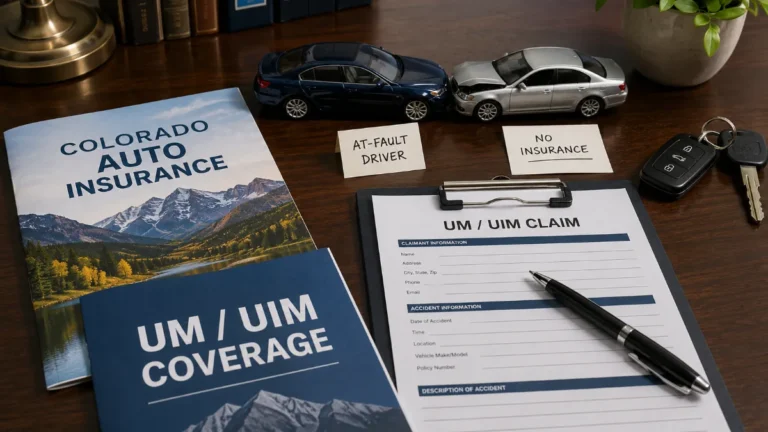
Colorado automobile policies generally must provide UM coverage protecting insured people who are legally entitled to recover bodily-injury or death damages from uninsured motorists unless the named insured rejects the coverage in writing. The insurer must offer UM limits equal to the policy’s bodily-injury liability limits, although the insured may select lower limits or reject the coverage as permitted by statute. Underinsured motorist protection is included within the statutory coverage. C.R.S. § 10-4-609(1), (2), and (4).
The declarations page is a starting point, not always the complete coverage analysis. When coverage appears to have been rejected or reduced, the written selection or rejection documentation may matter.
More than one policy may need to be reviewed
The policy covering the vehicle occupied during the crash is an obvious place to begin, but it may not be the only potentially relevant policy.
Depending on the policy definitions and circumstances, coverage might be associated with the injured person, the occupied vehicle, a resident relative, an employer, a rideshare or delivery platform, or another qualifying relationship.
That does not mean every identified policy will provide benefits. It means coverage should be investigated rather than assumed from one insurance card.
The complete policy, declarations, endorsements, and selection or rejection forms should be reviewed together.
Passengers, pedestrians, and bicyclists may also be insured
UM/UIM protection is not necessarily limited to the person driving the insured vehicle.
A qualifying insured may be protected while riding as a passenger, walking, bicycling, or occupying another vehicle. The result depends on the policy’s definition of an insured and the circumstances of the collision.
That distinction can be important after a pedestrian or bicycle crash when the responsible driver lacks insurance.
Hit-and-run and unidentified-driver claims
A driver who leaves the scene creates both an evidence problem and a coverage problem.
The collision should be reported promptly to law enforcement and the potentially applicable insurer. Vehicle damage, transferred paint, debris, dash-camera footage, nearby surveillance, witness information, and any description of the vehicle or driver should be preserved.
An insurer may investigate whether another vehicle actually caused the incident, particularly when no physical contact occurred. Prompt reporting and independent evidence can therefore be unusually important.
Why your own insurer still investigates the claim
A UM/UIM carrier may be your insurer, but it still evaluates what it owes under the policy.
The carrier may investigate who caused the crash, whether the claimant qualifies as an insured, whether another policy applies, whether the collision caused the claimed injuries, and the amount of legally recoverable damages.
A reasonable investigation does not become bad faith merely because the carrier asks questions or disagrees with the claimant. The carrier should nevertheless evaluate the material evidence, communicate its position, and avoid unreasonable delay or denial.
Be careful before releasing the at-fault driver
Do not sign a liability release before evaluating the potential UIM claim.
The policy and current law should be reviewed to determine what notice should be given, whether the UIM carrier asserts a contractual condition or subrogation interest, whether other responsible parties or policies exist, and whether the proposed release extends beyond the intended driver and liability policy.
Colorado law does not support reducing this issue to a universal statement that one procedure applies to every policy and every settlement. The language of the policy, the amount of undisputed damages, and the available underlying coverage can matter. The Colorado Supreme Court’s 2026 decision in United Services Automobile Association v. Wenzell, 2026 CO 25, illustrates why policy conditions and the facts triggering excess UIM obligations require careful attention.
The claimant still must establish damages
Subject to the policy and Colorado law, a UM/UIM claim may address medical expenses, future care, lost income, reduced earning capacity, physical impairment, disfigurement, pain and suffering, cognitive effects, and other legally recoverable bodily-injury damages.
The policy limit is the maximum amount potentially available under that coverage, not an automatic measure of the claim’s value. The evidence still must establish the covered loss.
Timing rules are specialized
Colorado generally provides a three-year limitations period for an action or arbitration seeking uninsured or underinsured motorist benefits. C.R.S. § 13-80-107.5(1)(a). The statute also contains specialized rules concerning accrual, the underlying bodily-injury claim, settlement, judgment, and discovery that the responsible driver lacked adequate insurance. Importantly, § 13-80-107.5(1)(b) provides that an insured may not have less than three years after the UM/UIM cause of action accrues. Because those provisions interact with the underlying claim and the particular facts, the ordinary motor-vehicle deadline should not be treated as answering every UM/UIM timing question.
A claimant should not assume that the ordinary motor-vehicle deadline answers every UM/UIM timing question. Nor should a claimant assume that continuing negotiation with either carrier preserves the insurance claim indefinitely.
Documents needed for a coverage review
- Every potentially applicable policy, declarations page, and endorsement;
- UM/UIM selection or rejection documents;
- The crash report, photographs, videos, and witness information;
- Confirmation of the at-fault driver’s policy limits;
- Medical records, bills, and future-care evidence;
- Employment and wage-loss documentation;
- Settlement offers and proposed releases; and
- Correspondence with every involved insurer.
Organization matters more than volume. A claim submission should explain how the evidence supports liability, coverage, causation, and the requested benefits.
UM/UIM coverage is easy to overlook
People often focus only on the at-fault driver’s insurance and treat that driver’s policy limit as the maximum possible recovery. That can be a costly assumption.
Rex Legal represents people pursuing uninsured and underinsured motorist benefits after Colorado crashes. The firm evaluates the underlying claim and the available first-party coverage before a permanent release is signed.
Tell Us What Happened.
Michael Rex can review what happened and what should occur next. Available 24 hours a day, 7 days a week.
This article is general information about Colorado law, not legal advice, and does not create an attorney-client relationship. Every case turns on its own facts.