

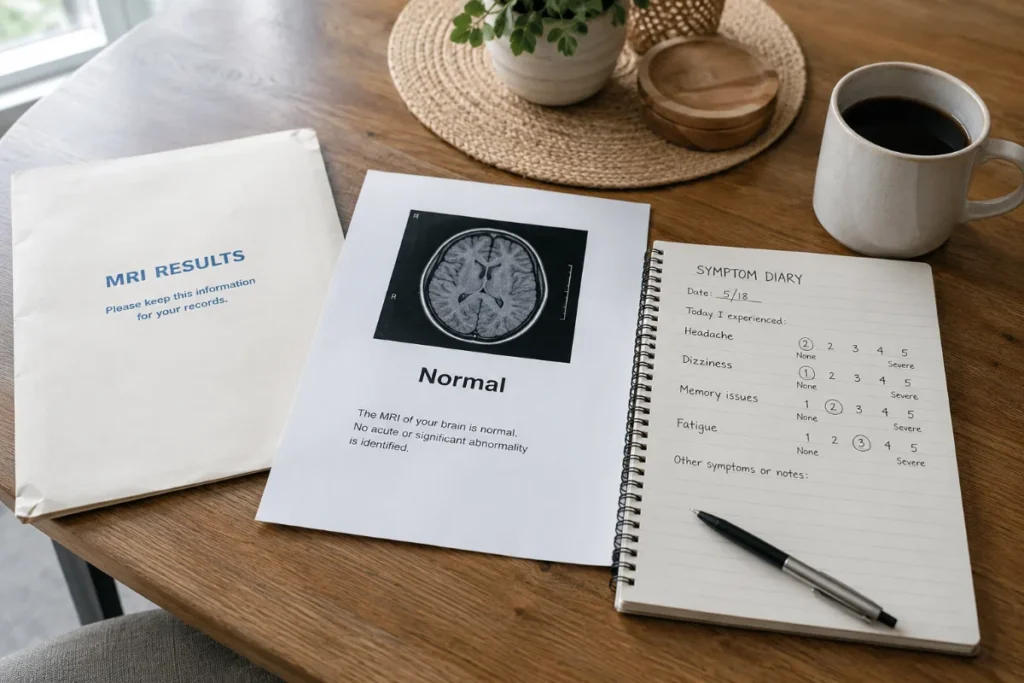
INSIGHT
Yes. A person can sustain a concussion or mild traumatic brain injury even when a CT scan or conventional MRI does not show an acute structural abnormality.
CT and MRI imaging can provide critical medical information. They are not designed to answer every question about how a person’s brain is functioning after trauma.
The Centers for Disease Control and Prevention explains that a brain scan such as a CT is not required to identify a mild traumatic brain injury or concussion. Imaging may instead be used when a healthcare provider is concerned about bleeding or another more serious structural injury.
What does a normal CT scan mean?
In an acute setting, a head CT can help healthcare providers evaluate conditions such as intracranial bleeding, skull fracture, swelling, or another structural injury requiring urgent treatment.
A normal result can therefore be reassuring. It may mean the scan did not identify the type of bleeding, fracture, or structural abnormality it was intended to detect.
It does not necessarily establish that the person’s memory, concentration, balance, vision, sleep, emotional regulation, or executive functioning remained unchanged after the trauma.
What about an MRI?
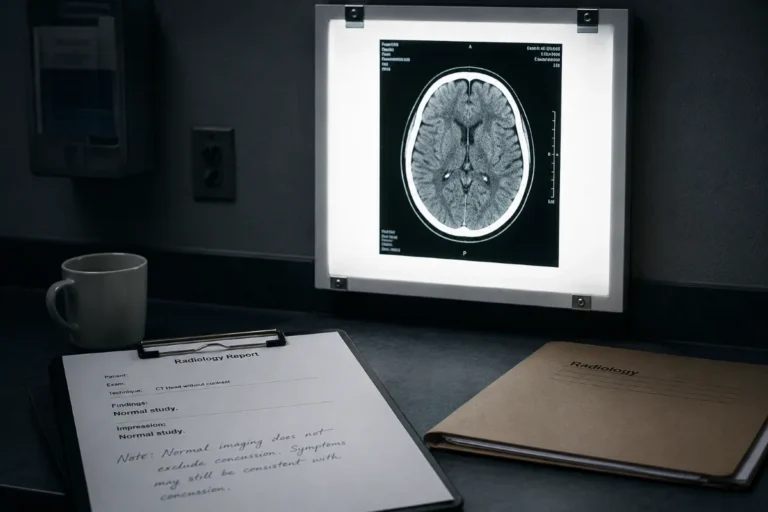
MRI can provide more detailed images of certain brain structures than CT and may be ordered based on the patient’s symptoms, history, examination, and the medical questions being investigated.
A conventional MRI can still be normal in a person diagnosed with a concussion or experiencing continuing post-concussion symptoms. That does not make the symptoms imaginary. It reflects the difference between identifying a visible structural lesion and evaluating changes in neurological function.
Advanced imaging techniques may have research or selected clinical uses, but no single image should be presented as a universal test for concussion, legal causation, or permanency.
How is a concussion evaluated?
Concussion is ordinarily a clinical diagnosis.
A healthcare provider may consider the mechanism of injury, whether the head or body was struck, any loss or alteration of consciousness, confusion, memory gaps, immediate and delayed symptoms, neurological findings, balance, eye movement, cognitive function, emotional changes, sleep, and the course of recovery.
Neurocognitive or neuropsychological testing may help identify difficulties involving learning, memory, concentration, or problem-solving. The CDC cautions that a mild TBI can still exist even when an injury does not appear on a particular neurocognitive test.
No single test should be forced to answer every question.
Brain injury symptoms are not limited to headaches
A brain injury can affect several areas of function at once.
Physical symptoms may include headache, dizziness, nausea, balance problems, fatigue, light sensitivity, noise sensitivity, vision changes, or reduced tolerance for activity. Cognitive symptoms may include slower processing, reduced concentration, short-term memory problems, word-finding difficulty, mental fatigue, and trouble organizing or switching between tasks.
Emotional and behavioral changes may include irritability, anxiety, depression, emotional volatility, reduced frustration tolerance, or feeling unlike oneself. Sleep may become fragmented, excessive, insufficient, or unrefreshing.
The CDC recognizes that concussion symptoms can affect how a person thinks, feels, acts, and sleeps, and that symptoms may appear immediately or become noticeable over the following hours or days.
Not every symptom after a crash or fall is necessarily caused by a brain injury. That is why accurate medical evaluation and a complete history matter.
Why symptoms may become apparent later
A person at an emergency department may be focused on pain, transportation, family, or simply getting through the immediate event. Cognitive fatigue may not become apparent until the person attempts to work. Noise sensitivity may emerge in a busy store. Memory problems may first be recognized by a spouse or coworker.
Delayed recognition is not the same as proof of causation, but it is also not an automatic reason to dismiss the symptom. The timeline should be documented honestly and evaluated medically.
Document function, not merely a diagnosis
The most useful records explain how the person’s abilities changed.
Medical and rehabilitation records may document symptoms, examination findings, treatment, restrictions, and progression. Employment records may show reduced hours, errors, missed work, accommodations, or failed attempts to resume prior duties. School records may show a need for additional time or reduced workload.
Family members, friends, and coworkers may identify changes in memory, patience, speech, initiative, organization, or personality that are difficult to observe during a short office appointment. Those witnesses should describe specific events rather than attempt to offer medical diagnoses.
A concise symptom-and-function journal may also help. It should identify meaningful limitations, activities that caused difficulty, medical appointments, and changes over time. Honest documentation includes improvement and good days, not only the worst moments.
Why insurers emphasize normal imaging
An insurer may point to normal imaging as evidence that no meaningful brain injury occurred.
Imaging is relevant evidence. It should be considered together with the mechanism of injury, acute symptoms, clinical findings, medical history, treatment, functional changes, prior baseline, and the observations of people who knew the injured person before and after the event.
A fair evaluation should not ask a CT scan to measure whether someone can still manage a complex workload, tolerate a noisy environment, remember appointments, regulate emotion, or complete familiar tasks without extraordinary effort.
Michael Rex takes brain injury cases personally
Michael Rex recovered from a serious traumatic brain injury early in his life and understands that these injuries are not always visible from the outside or captured by a single scan, diagnosis, or test result.
That experience informs how Rex Legal approaches these cases and why the firm is a proud supporter of the Brain Injury Alliance of Colorado, which generously provides resources for Coloradans affected by brain injuries.
Personal experience does not replace medical evidence. It does affect the care with which Rex Legal listens to clients, investigates functional changes, and presents injuries that are easily minimized because they are difficult to see.
When to seek immediate medical attention
Seek emergency care for concerning neurological changes such as:
- A severe or worsening headache;
- Repeated vomiting;
- Seizure;
- Increasing confusion or unusual behavior;
- Weakness, numbness, or reduced coordination;
- Slurred speech;
- Unequal pupils or double vision; or
- Difficulty waking or remaining awake.
This list is not exhaustive. A person who may have sustained a head injury should obtain guidance from an appropriate healthcare professional. The CDC advises immediate care for recognized concussion danger signs.
A normal scan is one part of the medical picture
The right question is not merely whether the imaging was described as positive or negative. The broader question is what happened to the person’s health, cognition, behavior, work, relationships, and ability to function after the injury.
Rex Legal represents Coloradans whose traumatic brain injuries have affected how they think, work, communicate, and live—even when those changes are not obvious to an outside observer.
Medical disclaimer: This article provides general information and is not medical advice. Possible brain injuries should be evaluated by a qualified healthcare professional.
Tell Us What Happened.
Michael Rex can review what happened and what should occur next. Available 24 hours a day, 7 days a week.
This article is general information about Colorado law, not legal advice, and does not create an attorney-client relationship. Every case turns on its own facts.