

INSIGHT
An insurer is not required to agree with every demand made by a policyholder. It is required to evaluate covered claims reasonably, in accordance with the policy and Colorado law.
A delayed, denied, or underpaid claim may result from missing information, a legitimate coverage question, a disagreement about causation or value, an incomplete investigation, an incorrect interpretation of the policy, or unreasonable claim handling.
The first step is not to label every disagreement bad faith. The first step is to determine precisely what the insurer decided, what facts and policy language support that decision, and what remains unresolved.
Identify the actual dispute
A coverage dispute concerns whether the policy applies at all. A scope dispute concerns what property, treatment, or loss is included. A valuation dispute concerns the amount owed. An investigation dispute concerns what information is reasonably necessary and whether the insurer is moving the claim toward a decision.
Those issues can overlap, but they should not be blurred together.
A property insurer may accept that a hail loss is covered but dispute whether a roof requires full replacement. A UM/UIM carrier may accept that its insured was injured but dispute whether particular treatment was caused by the crash. An insurer may agree that some benefit is owed while withholding another part of the claim.
A useful response identifies the precise disagreement rather than sending a generic accusation.
Obtain the complete insurance policy
A declarations page is not the complete contract.
Request the policy form, declarations, endorsements, amendments, schedules, and any coverage-selection or rejection forms that were effective on the date of loss. Read the insuring agreement, definitions, exclusions, conditions, and valuation provisions together.
An endorsement may add, remove, or change coverage described elsewhere. A summary supplied by an agent or adjuster does not replace the policy itself.
Ask the insurer to explain its position in writing
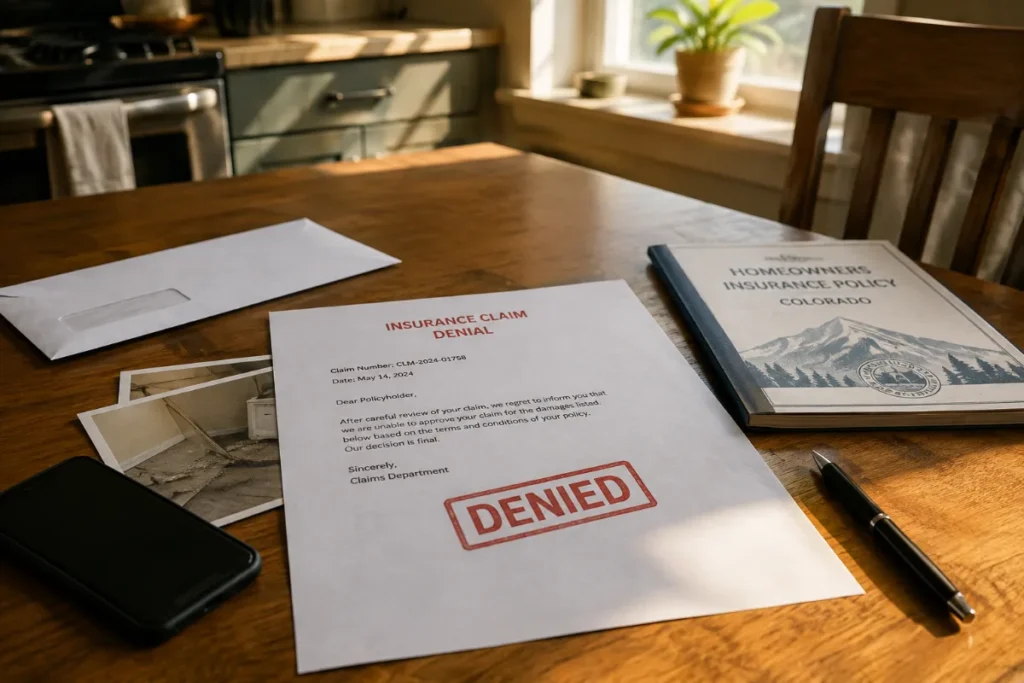
A denial or partial-payment letter should identify the coverage accepted, the coverage denied, the facts relied upon, the policy provisions applied, and the way any payment was calculated.
When the explanation is incomplete, ask focused questions. What fact remains disputed? What additional information is needed? Why is it material? Is the investigation complete? What amount is undisputed? What deadline does the insurer contend applies?
A quotation from an exclusion is not a complete explanation unless the insurer connects that language to the actual facts.
Build a claim chronology
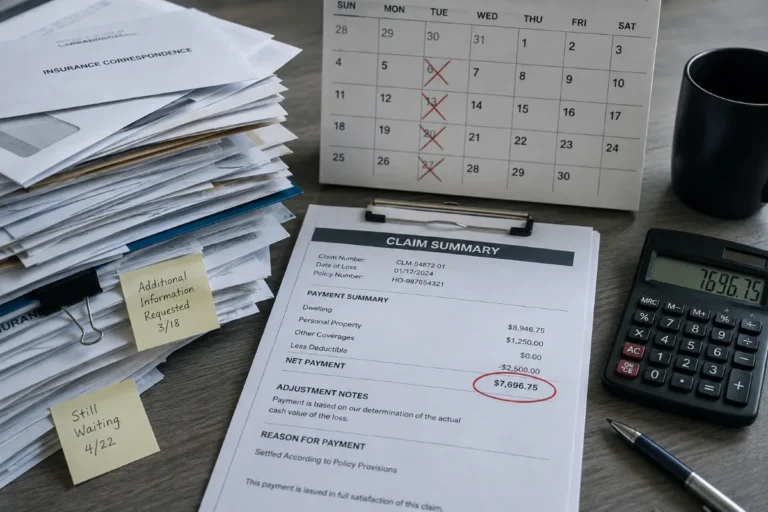
A claim chronology should record the date of loss, report date, inspections, adjuster assignments, documents submitted, requests received, estimates exchanged, payments issued, coverage letters, and periods without meaningful activity.
The chronology should identify what each party promised to do next. It can reveal whether the insurer is actively investigating, repeatedly circling the same issue, or allowing the file to sit without explanation.
Use the actual emails, letters, reports, and call notes. Do not reconstruct months of activity from memory when contemporaneous records exist.
Preserve the evidence
Depending on the claim, preserve the damaged property, photographs, estimates, receipts, repair records, engineering reports, medical records, wage information, recorded communications, and prior relevant documentation.
Do not discard a damaged component merely because the insurer inspected it once. If repairs are necessary to prevent further damage, document the condition thoroughly and give the carrier an appropriate opportunity to inspect when the policy requires it.
Preservation and mitigation can coexist. The policyholder can take reasonable steps to protect property while maintaining an accurate record of the original loss.
Continue reasonable cooperation
Insurance policies commonly require the insured to cooperate with a reasonable investigation. That may include producing relevant records, permitting an inspection, answering appropriate questions, submitting a proof of loss, or complying with other policy conditions.
Cooperation does not mean that every request is automatically proper or unlimited. A request may be unclear, repetitive, excessively broad, or unrelated to the disputed benefit. The better response is to address the request in writing, produce appropriate information, and explain any legitimate limitation or objection.
Ignoring a request can create a separate coverage dispute. Blindly complying without understanding it can create a different problem.
Separate the available legal claims
A claim for policy benefits asks what the insurance contract requires the carrier to pay.
A statutory unreasonable-delay or unreasonable-denial claim asks whether a covered first-party benefit was delayed or denied without a reasonable basis. C.R.S. § 10-3-1115(1)(a) prohibits unreasonable delay or denial of benefits owed to or on behalf of a first-party claimant. C.R.S. § 10-3-1116(1) authorizes a qualifying claimant to seek reasonable attorney fees, court costs, and two times the covered benefit. Those remedies are not automatic merely because the policyholder and insurer disagree.
A common-law first-party bad-faith claim requires a related but distinct showing. Colorado courts generally require proof that the insurer acted unreasonably and knew or recklessly disregarded the fact that its conduct was unreasonable. Goodson v. American Standard Insurance Co., 89 P.3d 409, 415 (Colo. 2004).
The contract, statutory, and common-law claims should not be treated as interchangeable labels.
Colorado regulates claim-handling practices
C.R.S. § 10-3-1104(1)(h) identifies unfair claim-settlement practices that include misrepresenting material policy provisions, failing to act reasonably promptly on claim communications, failing to maintain reasonable investigation standards, refusing payment without a reasonable investigation, and failing to explain the policy and factual basis for a denial or compromise offer.
Those provisions do not mean that every administrative mistake creates a private bad-faith action. They do identify claim-handling standards relevant to evaluating the carrier’s conduct.
A disagreement about value is not automatically unreasonable
Reasonable people can disagree about repair scope, depreciation, medical causation, future care, labor pricing, expert opinions, or the amount of noneconomic damages.
The question is not simply whether the carrier offered less than the policyholder requested. The more useful questions are whether it investigated the material facts, considered the submitted evidence, applied the policy consistently, and explained its conclusion.
An insurer does not establish reasonableness merely by calling every issue “fairly debatable.” A policyholder does not establish bad faith merely by showing that another estimate or opinion exists.
Identify the undisputed portion
A claim may contain both disputed and undisputed benefits.
Ask whether the insurer accepts any part of the repair scope, medical expenses, temporary housing, property value, or other claimed loss. When an amount is undisputed, ask when it will be paid and under which coverage.
Review any check and accompanying letter before acceptance. Determine whether the payment is described as partial, undisputed, or full and final, and whether the carrier is requesting a release.
Calendar every deadline independently
An open claim does not necessarily extend a statute of limitations, contractual suit limitation, proof-of-loss requirement, repair deadline, replacement-cost deadline, inventory period, appraisal requirement, or underlying liability deadline.
Request extensions before expiration and obtain them in writing. Do not rely solely on an adjuster’s statement that the claim remains open.
What about a Colorado Division of Insurance complaint?
A regulatory complaint may prompt a written response and create a clear record. It does not guarantee payment, replace litigation or appraisal, or automatically preserve a private deadline.
A useful complaint identifies the policy, claim number, disputed conduct, important dates, submitted evidence, and requested resolution without exaggerating the facts.
Turn the file into a clear record
The strongest response to an insurance dispute is often not a louder accusation. It is a complete policy, preserved evidence, an accurate chronology, and a precise explanation of what the insurer has failed to investigate, explain, or pay.
Rex Legal represents Colorado policyholders in property, MedPay, and UM/UIM disputes involving delayed, denied, or underpaid benefits.
Tell Us What Happened.
Michael Rex can review what happened and what should occur next. Available 24 hours a day, 7 days a week.
This article is general information about Colorado law, not legal advice, and does not create an attorney-client relationship. Every case turns on its own facts.