

INSIGHT
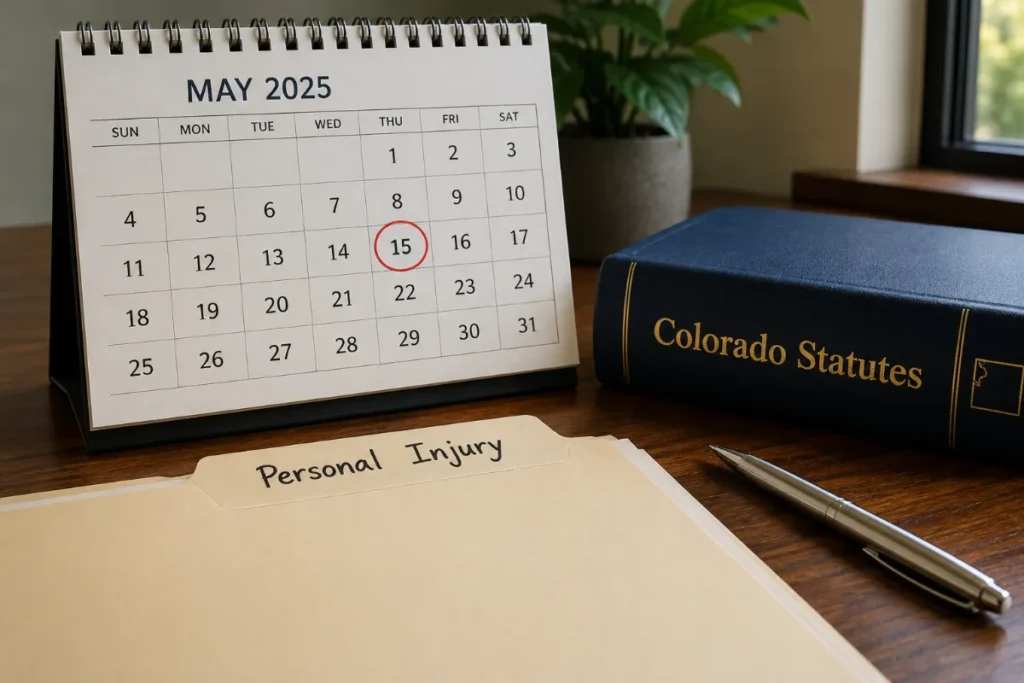
Colorado does not have one statute of limitations for every personal injury claim. The filing deadline depends on what caused the injury, who may be legally responsible, and which claims are available.
A person injured in a Colorado car crash will commonly be working with a different filing period than someone injured by a dangerous property condition. Claims involving defective products, wrongful death, public entities, ski-area operators, and uninsured or underinsured motorist benefits can involve still other rules.
That makes an online deadline chart useful only as a starting point. The actual analysis requires identifying every potentially responsible party, determining when each claim accrued, and checking for any notice requirement or policy deadline that may expire before the ordinary lawsuit deadline.
Common Colorado personal injury deadlines
- A bodily-injury or property-damage claim arising from the use or operation of a motor vehicle is generally subject to a three-year filing period under C.R.S. § 13-80-101(1)(n)(I).
- An ordinary negligence claim is generally subject to a two-year filing period under C.R.S. § 13-80-102(1)(a). That period commonly applies to claims governed by the Colorado Premises Liability Act, C.R.S. § 13-21-115.
- A product-liability action is generally subject to a two-year filing period under C.R.S. § 13-80-106(1).
- A wrongful death claim is generally subject to a two-year filing period under C.R.S. § 13-80-102(1)(d), with accrual ordinarily tied to the date of death under C.R.S. § 13-80-108(2).
- Certain actions against a ski-area operator or its employee are subject to a two-year filing period under C.R.S. § 33-44-111.
- A claim involving a Colorado public entity or public employee may require written notice within 182 days under C.R.S. § 24-10-109.
- Uninsured and underinsured motorist claims are generally subject to a three-year limitations period under C.R.S. § 13-80-107.5(1)(a), with specialized accrual and extension rules tied to matters including settlement, judgment, and discovery of inadequate insurance. Under § 13-80-107.5(1)(b), an insured may not have less than three years after the UM/UIM cause of action accrues.
These are general rules, not guaranteed deadlines for every claim bearing one of those labels. The statutory period can depend on the allegations, the identity of the defendant, the date of accrual, and the existence of a more specific statute.
When does the filing period begin?
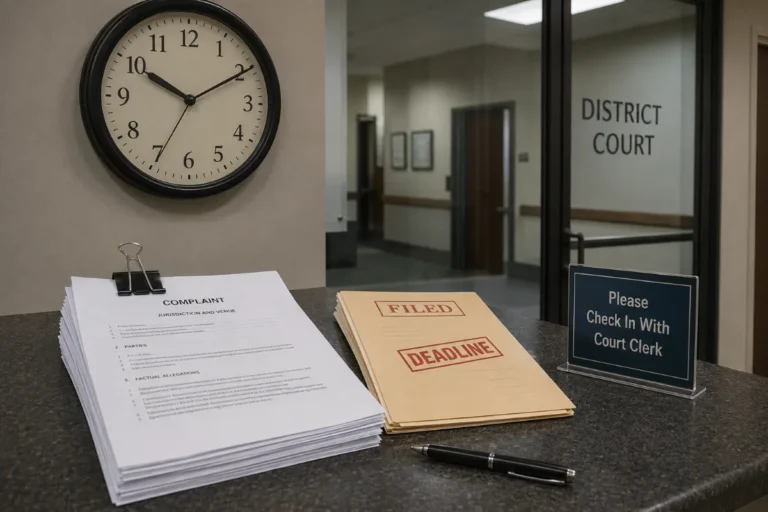
A filing period ordinarily begins when the claim “accrues.” For many Colorado injury claims, accrual occurs when the injured person knew—or reasonably should have known—both that an injury existed and that the injury was caused by another person’s conduct.
The date of the incident is therefore important, but it is not always the end of the analysis. A person may not immediately understand that a product was defective, that a recurring property condition caused a fall, or that an apparently temporary symptom reflects a more significant injury. Colorado’s discovery rules account for what the injured person knew or reasonably should have known, not merely the date on which a diagnosis was finally assigned. C.R.S. § 13-80-108 contains separate accrual provisions for bodily-injury, wrongful-death, motor-vehicle, contract, fraud, and other claims.
The discovery rule is not an invitation to wait indefinitely. Once available information would cause a reasonable person to recognize and investigate the injury and its cause, the limitations period may already be running.
Claims involving public entities have an earlier deadline trap
The Colorado Governmental Immunity Act creates one of the most serious deadline risks in Colorado injury law.
A person claiming injury caused by a public entity or a public employee acting within the course of employment generally must provide written notice within 182 days after discovering the injury. The statute expressly provides that the period can run even when the injured person does not yet know every element of the claim. The notice must contain required information and must be delivered to a proper recipient. C.R.S. § 24-10-109(1)–(3).
This issue can arise after crashes involving government vehicles, injuries on public property, dangerous roadway conditions, incidents involving public transportation, and claims involving schools or other governmental bodies. The responsible public entity may not be obvious from the name on a vehicle, the location of the incident, or the uniform worn by an employee.
The 182-day notice is separate from the deadline for filing the lawsuit. Completing one does not complete the other.
Insurance claims may have several separate clocks
An insurance dispute may involve a claim for policy benefits, a statutory unreasonable-delay claim, a common-law bad-faith claim, or some combination of those claims. Each can involve a separate accrual analysis.
The policy may also impose deadlines concerning notice, proof of loss, repair or replacement, recoverable depreciation, appraisal, cooperation, or filing suit. A contractual deadline is not automatically identical to the statute of limitations.
UM/UIM claims present an additional layer. C.R.S. § 13-80-107.5 contains specialized rules involving accrual, the underlying bodily-injury claim, settlement, judgment, and the discovery that the responsible driver lacked adequate insurance. The fact that a claimant still has time to pursue the at-fault driver does not necessarily answer the deadline question for every insurance claim.
Insurance negotiations ordinarily do not stop the filing period
Opening a claim, submitting medical records, sending a demand, or exchanging settlement offers is not the same as filing a lawsuit.
An adjuster may continue requesting information and negotiating while the limitations period runs. A claimant should not assume that the insurer will provide a final warning before the deadline expires. Nor should a claimant assume that the insurer’s decision to keep a claim “open” preserves every legal right.
There are circumstances in which an agreement or legal doctrine may affect the deadline. That conclusion should rest on an actual legal basis, not an informal statement that the carrier is still reviewing the file.
The evidence deadline often arrives first
A person can have substantial time remaining under the statute while important evidence is already disappearing.
Surveillance footage may be overwritten within days. Snow and ice melt. Vehicles are repaired or salvaged. A defective product may be returned, altered, or discarded. Electronic logging information, rideshare data, phone data, inspection records, and maintenance records may be retained for limited periods. Witnesses move and memories fade.
That means the practical deadline to preserve a claim may arrive much earlier than the formal deadline to file it.
What if the injured person is a minor?
Colorado law includes tolling and disability provisions that can affect claims belonging to minors and certain people under a legal disability. Those rules are fact-specific and should not be summarized as a blanket promise that a child always has until adulthood—or beyond—to act.
Even when tolling may apply, postponing an investigation can damage the evidence. A child’s claim should be evaluated promptly rather than placed on a distant calendar without identifying the responsible parties and preservation needs.
Does a demand letter preserve the claim?
Ordinarily, no. A demand letter may begin or advance settlement negotiations, but it generally does not commence a civil action or independently stop the limitations period.
The same is true of filing an insurance claim. The claim process and the litigation process are related, but they are not interchangeable.
Why deadline advice must be claim-specific
The right question is not simply, “What is Colorado’s personal injury statute of limitations?” The better questions are: What claims may exist? Against whom? When did each claim accrue? Does a public entity, insurance policy, federal law, or specialized statute affect the calculation?
Rex Legal represents people in serious Colorado personal injury and insurance disputes. Early review can identify the shortest potentially applicable deadline and preserve evidence before either one becomes a problem.
Tell Us What Happened.
Michael Rex can review what happened and what should occur next. Available 24 hours a day, 7 days a week.
This article is general information about Colorado law, not legal advice, and does not create an attorney-client relationship. Every case turns on its own facts.