

SKI & SNOWBOARD COLLISION CLAIMS
Colorado Ski Accident Lawyer
Skiing isn’t a contact sport. When another skier makes it one, call Rex.
When another skier causes a collision, Colorado law does not treat the crash as a risk you simply agreed to accept.
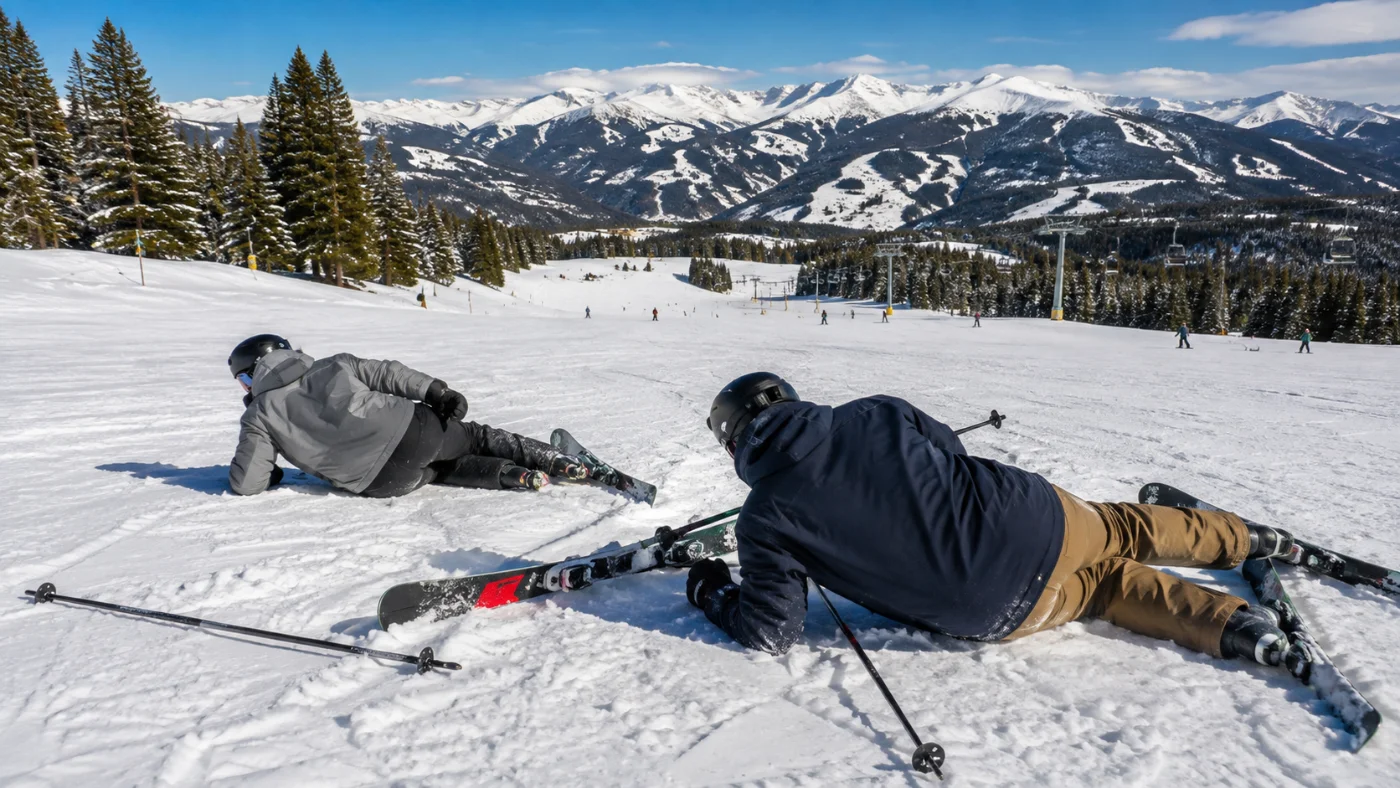
Colorado’s Ski Safety Act recognizes that skiing has inherent risks. It also draws a specific line between those risks and one skier’s responsibility to another.
C.R.S. § 33-44-109(1) says it directly: in an action by one skier against another, a skier-to-skier collision is neither an inherent risk of skiing nor a risk assumed by the injured skier. That makes collision cases fundamentally different from most claims against a ski resort.
Apply the Skier Duties.
Colorado gives skiers their own statutory rules of conduct. Every skier must maintain control of speed and course and keep a proper lookout so the skier can avoid other people and objects. C.R.S. § 33-44-109(2).
The statute also assigns the primary collision-avoidance duty to the skier traveling downhill toward people or objects below. In practical terms, the skier approaching from above has the primary responsibility to avoid the skier below. That is why a collision from behind on a ski run often starts with a very different liability analysis from two people converging at the same point from different directions.
Other rules matter too. Under § 33-44-109(8), a skier beginning from a stationary position or entering a trail from the side must avoid moving skiers already on the run. Every skier also has duties concerning posted warnings, control, lookout, and conduct that can contribute to injury.
Those statutory duties give the collision something concrete to measure. The question is not simply which skier tells the more convincing story afterward. It is where each skier was, how each was moving, and which duties applied at the moment of impact.
Identify the Other Skier.
A serious collision can become an identification problem almost immediately. The injured person may be taken down by ski patrol while the other skier remains mobile, finishes the day, and leaves the mountain.
Colorado law addresses that. Under C.R.S. § 33-44-109(10), a skier involved in a collision causing injury may not leave the vicinity before giving the skier’s name and current address to a ski-area employee or ski patrol. A person may leave temporarily to obtain aid, but must provide the information afterward. Violating that subsection is a petty offense.
Get the ski-patrol report. Confirm the other skier’s full name, current address, and phone number if available, along with any identifying information patrol collected. Preserve witness information before everyone gets back on a lift or heads down I-70.
A person who leaves without providing the required information has not automatically established civil liability for the collision. But disappearing from the scene creates an immediate practical problem: the person who may be responsible has to be found before any insurance can even be investigated.
Rebuild the Run.
Ski collisions rarely leave the kind of evidence available after a car crash. There may be no fixed camera, no police measurements, and no vehicle event data. The snow itself changes within hours.
Ski-patrol reports, witness accounts, helmet-camera or action-camera footage, phone video, photographs, trail maps, lift records, RFID scans, activity-tracking data, equipment damage, helmet damage, and photographs of the exact collision area can help reconstruct what happened.
Position matters. Who was uphill? Was one skier traversing? Did someone enter from the side? Had someone just started from a stationary position? Was the collision below a roll or terrain feature that affected visibility? What were the trail width, grade, traffic, weather, and light conditions?
Memory can also be incomplete after a high-energy collision. An injured skier’s inability to remember the impact is not evidence that the other skier acted reasonably. It makes independent evidence more important.
Find Personal Liability Coverage.
The person who caused the collision may have insurance even though neither skier was driving a car.
Homeowners and renters policies commonly include personal-liability coverage that can potentially apply to negligent conduct away from the insured’s residence, subject to the actual policy terms, exclusions, and insured relationships. An umbrella policy may provide another layer of personal-liability coverage.
That makes identification of the other skier particularly important. When the claim is against another skier, the insurance question is not whether the ski resort has coverage. It is whether the skier who caused the collision has a homeowners, renters, umbrella, or other policy that responds.
Coverage should be confirmed from the policy rather than assumed from the person’s homeownership status. A skier may rent, live with a relative, qualify as an insured under another household policy, or have no applicable personal-liability insurance at all.
Read the Waiver Narrowly.
Signing a season-pass agreement, lift-ticket agreement, or resort release does not automatically mean one skier released every other skier on the mountain from negligent conduct.
Resort releases are principally contractual agreements governing claims involving the resort and the parties identified in the agreement. Whether a particular release reaches any other person depends on its actual language and on Colorado law. The document should be read before anyone concludes that a skier-to-skier claim disappeared when the pass was purchased.
That distinction matters because the Ski Safety Act itself expressly preserves claims by one skier against another, and specifically provides that skier-to-skier collisions are not assumed risks in those actions. C.R.S. § 33-44-109(1).
Resort Claims Are Narrow.
Claims against ski-area operators are much harder. Colorado’s Ski Safety Act broadly bars recovery from a ski-area operator for injuries resulting from the statutory inherent dangers and risks of skiing. Those defined risks include changing snow and weather, trees and other natural objects, many terrain variations and man-made structures, and collisions with other skiers. C.R.S. §§ 33-44-103(3.5), 33-44-112.
A resort claim therefore usually requires something materially different: conduct outside the inherent-risk protection, violation of an applicable statutory or regulatory duty, or an injury involving passenger-tramway use or operation. A release or waiver can create another substantial obstacle.
Colorado also imposes special damages limits on qualifying claims against ski-area operators. C.R.S. § 33-44-113 generally caps total recovery at $1 million present value, derivative claims at $250,000, and noneconomic loss at $250,000. The provision excludes injuries occurring to a passenger while riding a passenger tramway and gives the court limited authority to exceed the general cap for specified excess future earnings or medical and health-care costs.
Those restrictions are another reason this page focuses primarily on collisions caused by other skiers rather than suggesting that every serious mountain injury creates a viable case against the resort.
Use the Ordinary Clock.
A negligence action against another skier generally falls under Colorado’s ordinary two-year tort limitations period in C.R.S. § 13-80-102(1)(a). The special limitations provision in the Ski Safety Act does not convert every ski-related injury into a resort claim.
C.R.S. § 33-44-111 separately imposes a two-year period on actions against a ski-area operator or its employees for injuries caused by the maintenance, supervision, or operation of a ski area or passenger tramway. The number of years happens to be the same, but the statute and the defendant are different.
Neither period is a reason to wait. Patrol records become harder to obtain, witnesses disappear, video is deleted, and memories of a few seconds on a crowded ski run deteriorate long before two years pass.
Prove the Medical Consequences.
A skier-to-skier collision can produce injuries far beyond a routine fall. Speed, body position, equipment, secondary impact with snow or ice, and collision with trees or other objects can create several injury mechanisms in seconds.
Traumatic Brain Injury.
Traumatic brain injury deserves its own record. A skier or snowboarder can sustain a traumatic brain injury despite wearing a helmet, and even when conventional imaging does not show dramatic structural damage. Amnesia, cognitive changes, headaches, balance problems, processing-speed changes, and other neurological effects require evidence separate from the orthopedic injuries.
Orthopedic and Spinal Injury.
Shoulder fractures, clavicle injuries, torn ligaments, knee injuries, wrist fractures, spinal damage, and other orthopedic trauma can require surgery, rehabilitation, and extended time away from work. Spinal cord injury, paralysis, and other permanent physical impairment may require the long-term medical and vocational analysis addressed in catastrophic injury claims.
Rex Legal Handles Collisions.
Rex Legal approaches a ski collision by identifying the other skier, applying Colorado’s skier duties, preserving the mountain evidence, locating available personal-liability insurance, and developing the medical record. Michael Rex remains directly involved from evaluation through resolution.
Ski Collision Questions.
Can I sue another skier or snowboarder who hit me?
Potentially, yes. C.R.S. § 33-44-109(1) expressly preserves claims by one skier against another and states that a skier-to-skier collision is not an inherent risk or an assumed risk in that action. Liability still has to be proved. Colorado’s skier duties concerning speed, control, lookout, downhill traffic, side entry, and starting from a stopped position can help determine whether the other skier acted negligently.
Is being hit by another skier an inherent risk of skiing in Colorado?
Not when one skier brings a claim against another skier. Although skier collisions appear in the statutory definition of inherent risks for purposes of claims against ski-area operators, C.R.S. § 33-44-109(1) specifically says a skier collision is neither an inherent risk nor a risk assumed by the injured skier in a skier-versus-skier action. The distinction between the defendant skier and the resort is critical.
Who has the right of way in an uphill-downhill ski collision?
C.R.S. § 33-44-109(2) places the primary duty on the skier traveling downhill to avoid people and objects below. Every skier must also control speed and course and keep a proper lookout. A skier entering from the side or beginning from a stationary position has a separate duty to avoid moving skiers already on the trail. The precise positions and movements therefore matter.
What if the other skier left without giving me their information?
Colorado law requires a skier involved in an injury collision to remain long enough to provide a name and current address to ski-area personnel or ski patrol, except when temporarily leaving to obtain aid. Violating that requirement is a petty offense. Obtain the patrol report immediately and preserve witness, video, lift-record, and other identifying evidence that may help locate the skier.
Does my season pass waiver prevent me from suing another skier?
Not automatically. A lift-ticket or season-pass release must be read according to its actual terms, and resort waivers principally concern claims involving the resort and the parties identified in the agreement. Colorado’s Ski Safety Act separately preserves claims between skiers and says skier-to-skier collisions are not assumed risks in those actions. Do not assume that buying a pass released an unrelated skier who later caused a collision.
Whose insurance pays when another skier causes a collision?
The other skier may have personal-liability coverage through a homeowners or renters policy, and an umbrella policy may provide additional coverage, depending on the policy terms and insured relationships. Skiing away from the insured’s home does not necessarily make residential personal-liability coverage irrelevant. The responsible skier first has to be identified so the applicable policies can be located and reviewed.
What evidence should I preserve, and how long do I have?
Preserve the ski-patrol report, the other skier’s information, witness contacts, photographs, helmet-camera or phone video, equipment and helmet damage, the trail location, lift records, and activity-tracking data. A skier-to-skier negligence claim generally has a two-year limitations period under C.R.S. § 13-80-102(1)(a), but mountain evidence can disappear within days or weeks. Preservation should begin long before the filing deadline approaches.
Can I sue the ski resort after a Colorado ski accident?
Sometimes, but resort claims are narrow. Colorado generally bars claims against ski-area operators for injuries caused by statutory inherent risks, and releases can create an additional obstacle. Claims involving specific statutory or regulatory violations, or passenger-tramway operation, can require a different analysis. Qualifying resort claims are also subject to the special limitations and damages provisions in C.R.S. §§ 33-44-111 and 33-44-113.
Tell Us What Happened.
If another skier or snowboarder caused a collision, Michael Rex can review the skier duties that applied, identify what mountain evidence remains, locate potential personal-liability coverage, and evaluate the resulting injuries. Available 24 hours a day, 7 days a week.