

INSIGHT
Colorado does not give every insurer exactly 30 or 60 days from the date a claim is first reported to finish the entire investigation and issue full payment.
A Colorado property-and-casualty regulation generally requires an insurer to make a claim decision or pay benefits due within 60 days after receiving a valid and complete claim, unless a reasonable dispute exists and the insured has complied with the policy. 3 CCR 702-5, Regulation 5-1-14, § 4(A)(1).
That is not the same as saying the 60-day period always begins when a claim number is assigned.
Colorado law separately prohibits unreasonable delay or denial of covered first-party benefits. The complete analysis depends on what information the insurer has, what remains legitimately disputed, what the policy requires, and what the carrier is doing with the time.
What does the 60-day regulation say?
Regulation 5-1-14 applies to insurers authorized to write property-and-casualty coverage in Colorado.
It generally requires a decision or payment within 60 days after receipt of a valid and complete claim unless there is a reasonable dispute and the insured has complied with the policy’s terms and conditions.
The regulation also states that a good-faith offer made within that period satisfies its timing requirement.
It should not be rewritten as:
Every Colorado insurer must fully pay every claim within 60 days after the loss is reported.
That version omits the regulation’s central qualifications.
What is a valid and complete claim?
The regulation describes a valid and complete claim through factors that can include receipt of the information necessary to prove the claim, completion of a reasonable investigation, compliance with policy conditions, establishment of coverage, completion of necessary repairs, completion of negotiation or appraisal, and resolution of relevant litigation.
Not every factor applies identically to every claim.
A property claim may require inspection, estimates, engineering work, inventories, or documentation of completed replacement. A UM/UIM claim may require liability evidence, medical records, confirmation of the responsible driver’s coverage, wage documentation, and proof of damages.
The point at which the claim becomes valid and complete can itself be disputed.
An insurer should not be permitted to leave a claim perpetually “incomplete” without identifying the specific missing information and explaining why it is necessary.
What is a reasonable dispute?
The regulation recognizes that a reasonable dispute may involve missing information, conflicting evidence, noncompliance with policy conditions, an unresolved coverage question, continuing investigation, litigation, negotiation, or appraisal.
The existence of a dispute does not make every length of delay reasonable. The insurer should still investigate actively, communicate clearly, and move the claim toward a decision.
A coverage question that reasonably required investigation at the beginning may become resolved after the insurer receives additional information. The carrier should not continue relying on the original uncertainty after the material issue has been answered.
Colorado requires continuing status explanations in covered circumstances
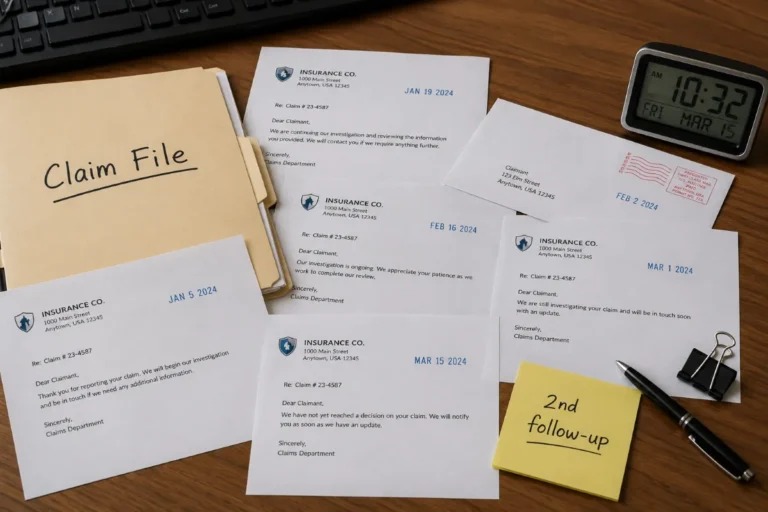
When an investigation remains incomplete and the insurer has not paid within the time required by Regulation 5-1-14, the regulation requires the carrier to notify the insured or representative of the reasons the claim has not been paid.
The regulation also generally requires a letter every 30 days thereafter explaining why additional investigation time is needed. 3 CCR 702-5, Regulation 5-1-14, § 4(B)(3).
Those letters do not automatically establish that the delay is reasonable. A repeated form letter stating that the investigation continues may provide little insight if it does not identify what is being investigated or what action the carrier is taking.
The insurer must also document in its claim file the investigative actions and efforts to conclude the investigation. Regulation 5-1-14, § 4(B)(4).
The regulation is not the only legal standard
C.R.S. § 10-3-1115(1)(a) prohibits an insurer from unreasonably delaying or denying payment of covered benefits owed to or on behalf of a first-party claimant.
C.R.S. § 10-3-1116 creates a private remedy for a qualifying unreasonable delay or denial. That statutory analysis is distinct from an administrative regulation and should not be reduced to whether a particular number of days passed.
C.R.S. § 10-3-1104(1)(h) separately identifies unfair claim-settlement practices, including failing to act reasonably promptly on communications, failing to maintain reasonable investigation standards, refusing payment without a reasonable investigation, failing to affirm or deny coverage within a reasonable time after proof of loss, and failing to explain the policy and factual basis for a denial or compromise offer.
C.R.S. § 10-3-1104 identifies regulated practices. It does not independently create the private cause of action available under C.R.S. §§ 10-3-1115 and 10-3-1116.
A violation of the 60-day regulation should not be described as automatically proving bad faith. Likewise, remaining technically outside a simplistic 60-day calculation does not automatically make a prolonged delay reasonable.
Ask what remains outstanding
A useful written request should force the issue into specific questions.
- Does the insurer consider the claim valid and complete?
- If not, what specific information remains necessary?
- Why is each requested item material to coverage or valuation?
- What investigation remains unfinished?
- Who is responsible for completing it?
- When does the insurer expect the investigation to conclude?
- Which portions of coverage or value are accepted?
- Is any amount undisputed?
- What policy provision governs the outstanding request?
- Does the insurer contend that any policyholder deadline is approaching?
That record is more useful than repeatedly asking, “When will you pay?”
Ask about the undisputed amount
A claim may contain both disputed and undisputed benefits.
A property insurer may accept part of the repair scope but dispute replacement of another component. A UM/UIM carrier may accept some medical expenses but dispute future care. A carrier may accept temporary housing but dispute how long it should continue.
Ask the insurer to identify the amount it does not reasonably dispute and when that amount will be paid.
Review any check and accompanying letter before acceptance. Determine whether the payment is partial, undisputed, or offered in exchange for a release.
Maintain a claim chronology
Track the report date, inspections, information requests, responses, expert assignments, coverage letters, estimates, payments, adjuster changes, recorded statements, examinations under oath, appraisal activity, and periods without substantive communication.
The chronology may show that the delay resulted from a legitimate investigation, missing information, repeated insurer inactivity, or a combination of those causes.
Do not assume that every quiet period is unreasonable. Do not assume that a carrier can justify months of inactivity merely by leaving the file formally open.
Continue reasonable cooperation
A policyholder should not create delay by ignoring reasonable requests.
Provide relevant information, identify documents already produced, explain what cannot be provided, request clarification, and ask that excessively broad requests be narrowed.
Cooperation does not require automatic agreement with every demand. It does require addressing legitimate investigative needs rather than allowing silence to create a separate coverage issue.
Keep other deadlines on the calendar
An open insurance investigation does not necessarily extend a statute of limitations, proof-of-loss deadline, appraisal period, repair deadline, replacement-cost deadline, inventory requirement, or deadline affecting an underlying liability claim.
Ask for extensions before expiration and obtain them in writing.
The better question is what the insurer is doing with the time
A meaningful delay analysis asks more than how many days have passed. It asks whether the insurer has investigated, communicated, addressed material evidence, paid undisputed benefits, and provided a reasonable explanation.
Rex Legal represents Colorado policyholders in property and automobile insurance disputes involving delayed, denied, and underpaid benefits.
Tell Us What Happened.
Michael Rex can review what happened and what should occur next. Available 24 hours a day, 7 days a week.
This article is general information about Colorado law, not legal advice, and does not create an attorney-client relationship. Every case turns on its own facts.