

INSIGHT
An injured person does not have to prove perfect conduct to recover under Colorado negligence law.
Colorado permits a claimant to recover when the claimant’s own negligence was less than the negligence of the person against whom recovery is sought. The damages are then reduced in proportion to the claimant’s assigned percentage of negligence. C.R.S. § 13-21-111(1).
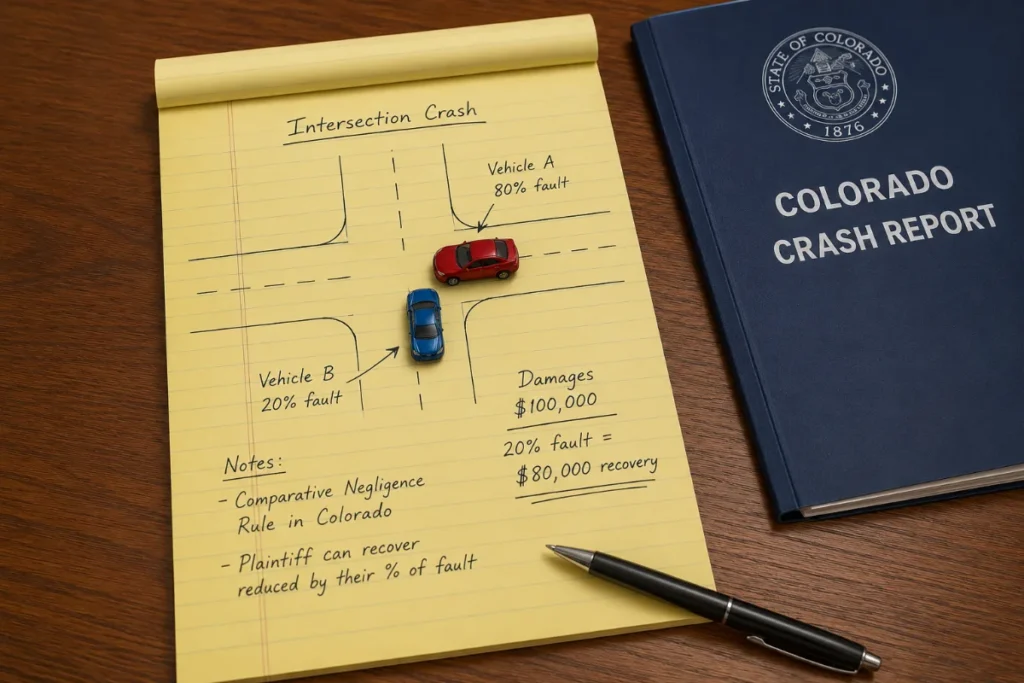
In a straightforward claim involving one defendant, a claimant found 20 percent at fault may recover 80 percent of the proven damages. A claimant found 49 percent at fault may still recover a reduced amount. A claimant found equally at fault—50 percent against a defendant who is also 50 percent at fault—generally cannot recover from that defendant.
That is why Colorado is commonly described as using a modified comparative-negligence rule.
How the reduction works
Assume a jury determines that the claimant sustained $200,000 in damages. It assigns 25 percent of the negligence to the claimant and 75 percent to the defendant.
The court would ordinarily reduce the damages by the claimant’s 25 percent share, producing a $150,000 judgment before addressing insurance limits, liens, costs, or other legal issues.
C.R.S. § 13-21-111(2) requires the fact finder to determine the damages that would have existed without claimant negligence and to state each party’s percentage of negligence. The court then applies the proportional reduction under subsection (3).
The percentage is therefore not merely a label. It directly affects the recoverable amount.
Fault and damages are separate questions
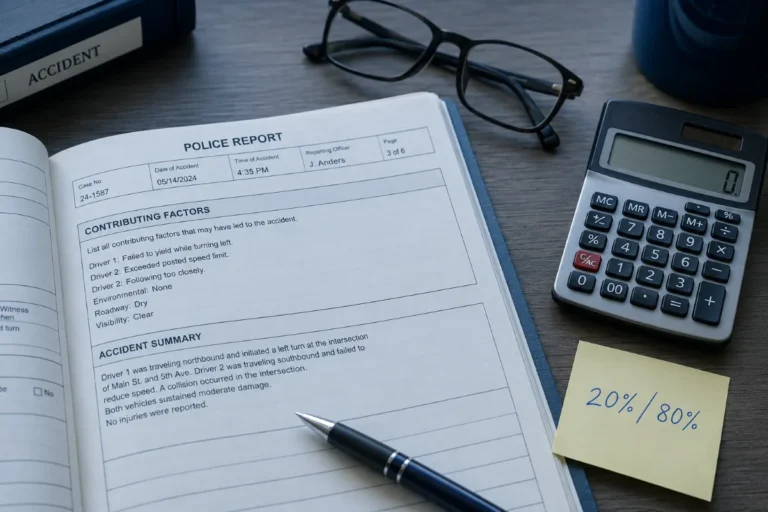
A shared-fault argument concerns responsibility for causing the incident. It does not determine whether the injury exists or what the injury is worth.
An insurer may accept that its driver was primarily responsible but still dispute the medical causation, duration of symptoms, future care, lost income, or amount of noneconomic harm. Conversely, the parties may agree about the injuries but sharply dispute who caused the collision.
Those issues should be analyzed separately rather than allowing a general allegation of “comparative negligence” to stand in for the entire claim evaluation.
An insurer’s percentage is not binding
A liability carrier may announce that the injured person was 20, 30, or 40 percent at fault. That is the carrier’s claim position, not a judicial determination.
The carrier should be asked what conduct it contends was negligent, what evidence supports that position, and how the alleged conduct contributed to the incident.
Colorado’s unfair-claim-settlement-practices statute specifically identifies raising comparative negligence as a defense or partial offset in a third-party claim without conducting a reasonable investigation and developing substantial supporting evidence. C.R.S. § 10-3-1104(1)(h)(XV).
That provision identifies a regulated claim practice. It should not be described as creating an independent private cause of action. The point for the reader is narrower: an insurer should not assign shared fault arbitrarily or without evidence.
Comparative negligence after a car crash
In a motor-vehicle claim, a carrier may allege that the injured driver was speeding, distracted, following too closely, making an unsafe lane change, failing to keep a lookout, or reacting unreasonably to a hazard.
The response may depend on vehicle positions, impact locations, dash-camera footage, event data, phone records, witness accounts, traffic-signal timing, roadway design, skid marks, and statements made after the crash.
A phrase such as “I never saw the other vehicle” does not necessarily establish negligent lookout. The vehicle may have entered suddenly, approached from an obstructed area, or remained outside the person’s field of view until the collision was unavoidable.
That is one reason an unplanned recorded statement can create problems. See Should I Give an Insurance Adjuster a Recorded Statement After a Colorado Crash?.
Comparative negligence in premises-liability claims
A landowner may contend that a claimant saw or should have seen a condition, ignored a warning, used an unsafe route, looked at a phone, wore unsuitable footwear, or failed to use a handrail.
The claimant may have evidence that the condition was concealed, lighting was poor, the warning was inadequate, the route was designated for customer use, or no reasonable alternative was available.
The Colorado Premises Liability Act expressly applies comparative-negligence principles to covered claims. C.R.S. § 13-21-115(3).
The issue is not resolved merely by describing a condition as obvious. The conduct of the landowner and the claimant, the available alternatives, and the cause of the injury all require evidence.
Comparative negligence in skier collisions
Colorado imposes duties on each skier to maintain control, maintain a proper lookout, heed posted warnings, and avoid conduct that may contribute to another person’s injury. C.R.S. § 33-44-109.
The person skiing downhill from above bears the primary duty to avoid people and objects below. A skier starting from a stationary position or entering a trail from the side has a separate duty to avoid moving skiers already on the trail.
Those duties do not make every collision automatically 100 percent the fault of whichever person was higher on the slope. Trail entry, movement, speed, lookout, visibility, and the complete sequence may all matter.
Comparative negligence involving bicyclists and pedestrians
A driver’s duty to use reasonable care does not disappear because a pedestrian or cyclist may also have violated a traffic rule.
Potential issues may include the crossing location, traffic signals, bicycle direction, lane position, lighting, clothing visibility, turning movements, vehicle speed, distraction, and whether either person had a reasonable opportunity to avoid the collision.
A citation may be relevant, but it does not necessarily decide every question of civil fault or causation.
Preserve evidence supporting—or refuting—the allegation
The strongest response to an inflated fault allegation is evidence rather than outrage.
- Preserve photographs, surveillance video, dash-camera footage, and witness information.
- Keep police reports, incident reports, and original recorded statements.
- Preserve vehicles, equipment, and other relevant physical evidence.
- Save unaltered text messages, phone information, and electronic data when relevant.
- Document the condition and geometry of the scene before they change.
- Identify the specific law, duty, or conduct the insurer claims was violated.
Do not destroy evidence because it appears unfavorable. A complete and truthful record is more defensible than a selective one.
Multiple-party cases are more complicated
A collision or injury may involve several responsible people or entities. Colorado’s pro rata liability statute, C.R.S. § 13-21-111.5, can permit fault to be allocated among defendants and properly designated nonparties.
That can affect both the threshold analysis and the amount collectible from each defendant. A simple online calculator built around one claimant and one defendant may not accurately address a multi-party case.
Partial responsibility is not the same as no claim
Real-world injuries sometimes involve imperfect conduct by more than one person. Colorado law does not require an injured claimant to establish flawless behavior.
Rex Legal investigates the complete sequence, the duties of every involved party, and the evidence supporting—or undermining—an insurer’s proposed fault allocation.
Tell Us What Happened.
Michael Rex can review what happened and what should occur next. Available 24 hours a day, 7 days a week.
This article is general information about Colorado law, not legal advice, and does not create an attorney-client relationship. Every case turns on its own facts.