

INSIGHT
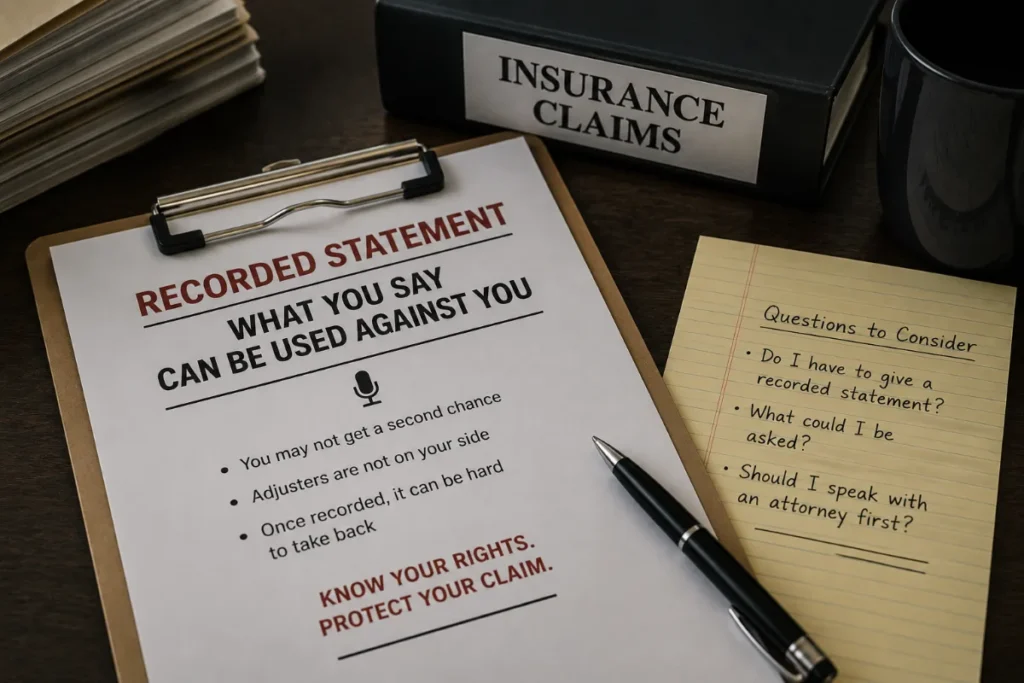
Do not treat every request for a recorded statement the same.
A request from the other driver’s liability insurer is fundamentally different from a request made by your own insurer under a policy that may require cooperation or specific information.
In many prelitigation circumstances, an injured person has no contractual duty to give the opposing driver’s carrier an immediate recorded statement. The injured person’s own carrier may have a contractual right to investigate the claim and request relevant information. The scope of that obligation depends on the policy, the requested information, and Colorado law.
The safest response is neither an automatic yes nor an automatic refusal. First identify who is asking, whom the insurer represents, why the statement is requested, and whether a contractual obligation applies.
What is a recorded statement?
A recorded statement is an interview preserved as audio, video, or a transcript.
An adjuster may ask about the collision, speed, distance, traffic controls, vehicle positions, injuries, treatment, prior medical history, employment, lost income, household members, and other insurance coverage.
The statement may later be used to evaluate fault, coverage, causation, damages, credibility, or compliance with the policy.
A recorded statement is different from a deposition or an examination under oath. It should also be distinguished from the basic information needed to report a claim.
A request from the other driver’s insurer
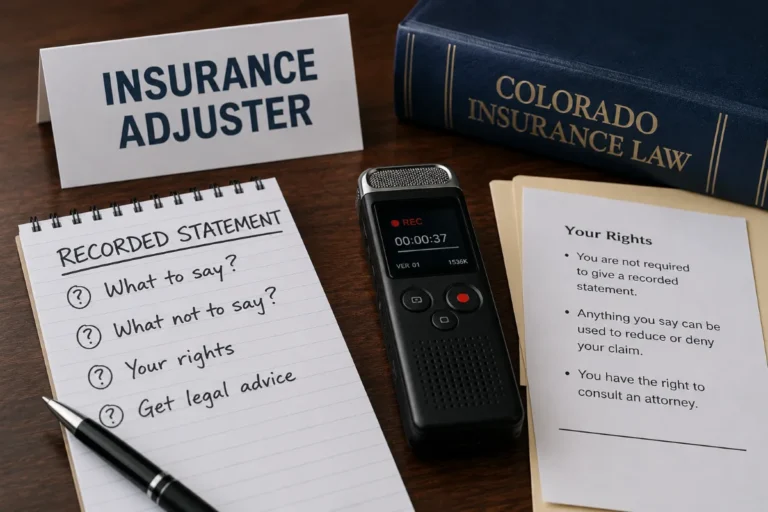
The other driver’s liability carrier protects its insured against covered claims. Its adjuster may be courteous and professional, but the carrier is investigating whether it owes money on behalf of the other driver and, if so, how much.
The carrier may seek statements bearing on comparative negligence, speed, distraction, seat-belt use, symptom timing, prior injuries, treatment gaps, work, or activities after the collision.
An injured person ordinarily should not assume that the adverse carrier is entitled to an immediate recorded interview merely because the adjuster describes it as routine.
A polite response may be:
Please give me your name, company, claim number, and the name of the insured you represent. I am not prepared to provide a recorded statement during this call. Please send the request and the subjects you wish to discuss in writing.
That response does not conceal information or announce a permanent refusal. It creates an opportunity to understand the request before participating.
A request from your own insurer
The analysis changes when the request comes from a carrier that issued an applicable policy.
The insurer may be investigating collision coverage, MedPay, UM/UIM coverage, a hit-and-run, or another first-party benefit. The policy may require the insured to cooperate with a reasonable investigation or satisfy specific duties after a loss.
Ignoring the request can create a coverage issue. At the same time, a general cooperation provision does not automatically make every question, authorization, or deadline reasonable.
The complete policy should be reviewed to identify the contractual duty the insurer is invoking.
Colorado’s early-statement protection is narrow but important
Colorado law provides specific protections to certain injured patients shortly after an incident.
When the injured person is under the care of a healing-arts practitioner or hospitalized, an adverse person or agent generally may not obtain a written, oral, or recorded statement from that patient within 15 days for use in negotiating a settlement or obtaining a release. The statute also generally restricts an adverse person from negotiating a settlement or obtaining a general release from that patient within 30 days. C.R.S. § 13-21-301(1). citeturn632975view0
This is not a universal rule that no insurer may contact any injured person for 15 or 30 days. The injured person’s medical status, the identity and interests of the person seeking the statement, the timing, and the intended use of the statement all matter.
Why an immediate statement can create problems
Most people do not intend to give inaccurate information. Problems arise because the statement occurs before the facts or medical picture are clear.
A person may not know the precise speed or distance. The person may not have seen what occurred outside the field of view. Pain, medication, sleep deprivation, shock, anxiety, or concussion symptoms may affect memory and communication.
Injuries may also evolve. A person focused on shoulder pain may not yet recognize a headache, cognitive change, knee instability, or sleep disruption. An early statement that “my shoulder is the only thing bothering me” can later be presented as though it were a definitive medical conclusion.
Ordinary conversational phrases create similar risks. “I’m okay” may mean only that the person is conscious and does not need an ambulance. “I didn’t see him” may mean that another vehicle entered suddenly or came from an obstructed area. The recording may preserve the phrase without the context.
Colorado regulates failure-to-cooperate defenses
C.R.S. § 10-3-1118 imposes procedures an insurer generally must follow before asserting a failure-to-cooperate defense based on a general cooperation obligation in a first-party coverage action.
Among other requirements, the insurer must make a qualifying written request, seek information reasonably necessary to adjust the claim or prevent fraud, provide time to respond, provide a written opportunity to cure an alleged failure, and establish material prejudice to the affected portion of the claim. The statute also provides that an insured’s duty to cooperate does not relieve the insurer of its own duty to investigate. citeturn668129view1
That does not mean every specific condition in a policy is governed identically. In United Services Automobile Association v. Wenzell, 2026 CO 25, the Colorado Supreme Court distinguished a defense based on a policy’s general cooperation clause from a defense based on failure to satisfy a specific contractual condition precedent. citeturn668129view2
The practical lesson is simple: take a request from your own insurer seriously, identify the policy provision involved, and do not assume either that every demand is unlimited or that every request may safely be ignored.
Questions to ask before agreeing
- Which insurer and adjuster are requesting the statement?
- Whom does the insurer represent?
- Which claim and coverage are being investigated?
- Is the statement voluntary, or does the insurer contend that the policy requires it?
- Which subjects will be discussed?
- Will the full conversation be recorded?
- Will the insurer provide the audio and transcript?
- Is the interview under oath?
- May counsel attend?
- What deadline does the insurer contend applies?
Obtain the answers in writing when possible.
How to prepare for an appropriate statement
Preparation should improve accuracy, not create a memorized performance.
Review the date, time, location, basic sequence, photographs you personally took, treatment to date, current symptoms, relevant prior conditions, missed work, and earlier communications with the insurer.
Identify facts you genuinely do not know or remember. Distinguish what you personally observed from information learned afterward.
During the interview, listen to the entire question. Ask for clarification when needed. Do not guess or accept an estimate suggested by the adjuster when you cannot make it reliably. Correct a misunderstanding promptly. “I do not know” and “I do not remember” are accurate answers when they are true.
Truthfulness includes avoiding both exaggeration and minimization.
Medical authorizations are a separate issue
A recorded-statement request may be accompanied by a medical authorization.
Read the authorization separately. Determine which providers and time periods it covers, whether it reaches unrelated conditions, whether it permits repeated future access, and whether a narrower authorization or direct production of relevant records would satisfy the legitimate need.
An injured person should not conceal relevant prior medical history. That does not mean every insurer is automatically entitled to every medical, psychological, employment, educational, or financial record ever created.
A recorded statement is not an examination under oath
An examination under oath, often called an EUO, is ordinarily more formal. It may involve testimony under oath, a court reporter, detailed document requests, questioning by an attorney, and specific policy provisions governing attendance.
An EUO notice should not be treated as an ordinary scheduling email. The policy and requested materials should be reviewed before proceeding.
What if the statement has already been given?
Do not panic. An imperfect statement does not automatically destroy a valid claim.
Write down when it occurred and who participated. Request the recording and transcript. Preserve the communications surrounding the interview. Do not attempt to “fix” the statement through a series of informal calls.
When a material answer was inaccurate, correct it clearly and truthfully through an appropriate communication. Differences may have legitimate explanations involving evolving symptoms, later-obtained information, or an honest failure of memory.
The identity of the insurer changes the answer
A request from the other driver’s insurer and a request from your own insurer are not legally interchangeable.
The adverse carrier generally does not have a policy relationship with the injured claimant. The claimant’s own carrier may have legitimate contractual rights to information and cooperation. Either way, a formal recorded interview should be understood before it begins.
Rex Legal represents people injured in Colorado crashes and policyholders involved in MedPay, UM/UIM, and first-party automobile insurance disputes.
Tell Us What Happened.
Michael Rex can review what happened and what should occur next. Available 24 hours a day, 7 days a week.
This article is general information about Colorado law, not legal advice, and does not create an attorney-client relationship. Every case turns on its own facts.