

PREMISES LIABILITY CLAIMS
Denver Premises Liability Lawyer
In Colorado, the same dangerous condition can create a different legal duty depending on why the injured person was there.
A customer walking through a grocery store, a social guest entering a home, and a person crossing property without permission can encounter the same patch of ice or broken stair. Colorado law does not treat those people the same.
The Colorado Premises Liability Act, C.R.S. § 13-21-115, supplies the exclusive premises-liability remedy against a landowner for injuries within the Act’s scope. The first question is therefore not simply whether the property was dangerous. It is who qualifies as a landowner, what legal status the injured person had, and what duty followed from that status.
Status Controls the Duty.
“Landowner” means more than the person whose name appears on the deed. Under the Act the term includes, without limitation, an authorized agent, a person in possession of the property, and a person legally responsible for the property’s condition or for activities or circumstances existing there. Depending on the facts, an owner, tenant, property manager, or another responsible party can therefore require examination.
The Act then places the injured person into one of three categories, and the category determines the duty the landowner owed.
Invitees Receive the Highest Duty.
An invitee generally enters to transact business in which the parties have a mutual interest, or because the landowner has expressly or impliedly represented that the public is expected or intended to enter. Customers in stores, restaurants, hotels, and other businesses are common examples.
An invitee may recover for damages caused by the landowner’s unreasonable failure to exercise reasonable care to protect against dangers the landowner actually knew about or should have known about. A statutory exception applies to property classified for tax purposes as agricultural or vacant land.
Licensees Require Actual Knowledge.
A licensee enters or remains with the landowner’s permission for the licensee’s own convenience or interests. The statute specifically includes social guests.
The standard is narrower. A licensee may recover for the landowner’s unreasonable failure to exercise reasonable care concerning a danger the landowner created and actually knew about, or for an unreasonable failure to warn about certain dangers the landowner did not create but actually knew about. Constructive knowledge is not substituted for the statute’s actual-knowledge requirement.
Trespassers Receive Limited Protection.
A trespasser enters or remains without the landowner’s consent. Under the Act, a trespasser may recover only for damages willfully or deliberately caused by the landowner. The Act separately preserves Colorado’s attractive-nuisance doctrine for children under fourteen.
Status is not necessarily fixed for an entire visit. A person can enter a business as an invitee and exceed the scope of the invitation by entering an area not open to customers. Status can change while a person remains on the property, which makes the location of the incident and the reason the person was there part of the liability analysis.
Notice Has to Be Proved.
In many slip-and-fall and trip-and-fall cases, the decisive question is notice. Did the landowner know about the condition? If the injured person was an ordinary invitee, should the landowner have known about it through reasonable care?
Actual notice can come from an employee seeing the hazard, a prior complaint, a work order, an earlier incident, or evidence that the landowner created the condition. Constructive notice is different. It asks whether the circumstances were such that a landowner exercising reasonable care should have discovered the danger.
Time can be critical. A spill that occurred seconds before a customer entered an aisle presents a different notice problem from liquid that remained on the floor through multiple inspection cycles. There is no universal number of minutes that creates liability. Surveillance, inspection practices, employee testimony, footprints, track marks, weather conditions, and the appearance of the hazard can help establish how long it existed.
Slip Hazards Leave Clues.
Slip claims can involve water, grease, spilled products, leaking refrigeration equipment, freshly mopped floors, ice, snow, and other low-friction surfaces. The investigation should ask where the substance came from, whether the condition recurred, who inspected the area, what warnings existed, and when anyone last documented the surface.
Trip Hazards Need Measurement.
Trip-and-fall cases often turn on a physical defect: broken concrete, an elevation change, damaged flooring, loose mats, potholes, exposed hardware, poor transitions between surfaces, or objects left in a walking path. Photographs should show more than the general scene. Measurements, lighting, contrast, approach angle, and the route a pedestrian would ordinarily take can explain why the condition was dangerous.
Snow and Ice Differ.
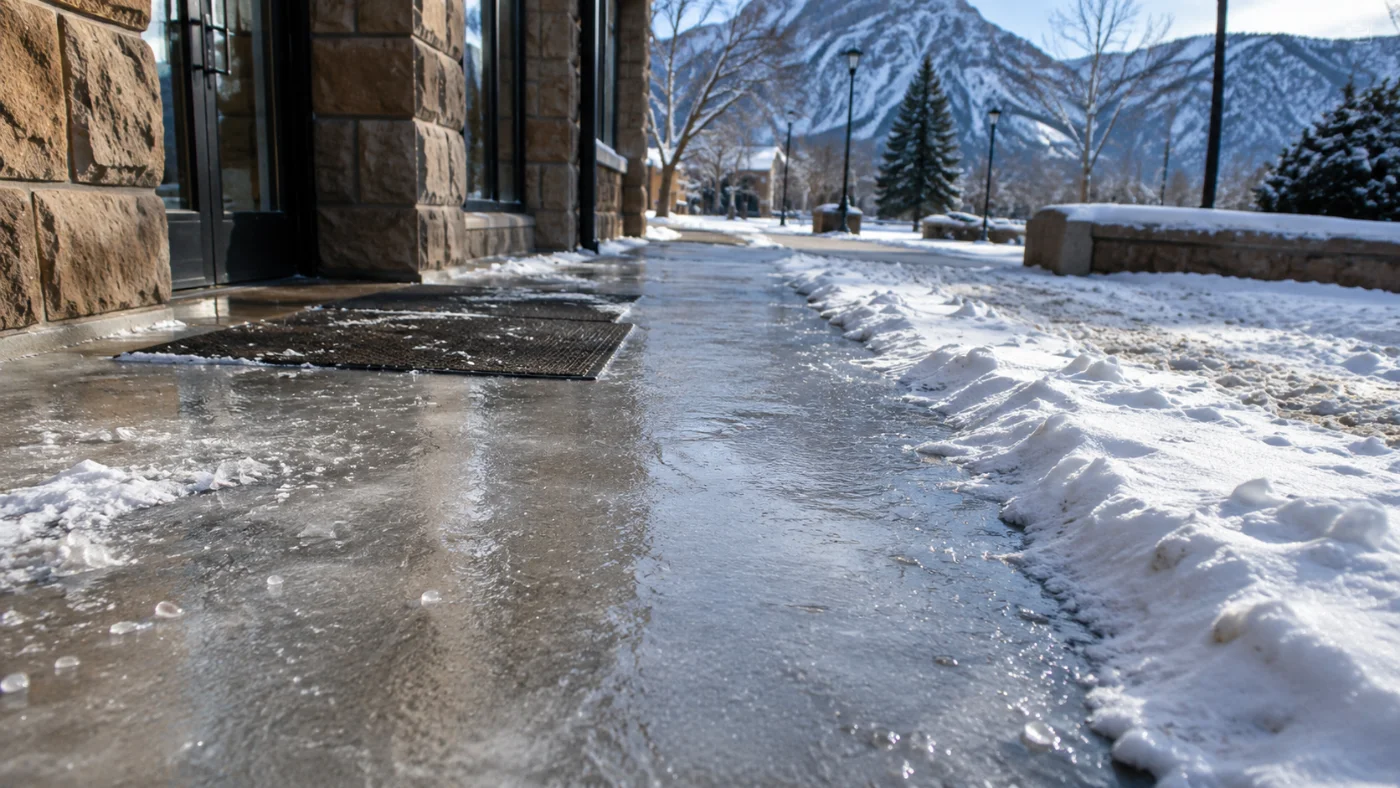
Colorado winter conditions do not make every fall on snow or ice actionable. On property within the Act, the injured person’s statutory category and the landowner’s required knowledge still control. Evidence can include weather history, inspection and treatment records, drainage patterns, repeated melting and refreezing, plowing practices, prior complaints, and whether the same area regularly accumulated ice.
A public sidewalk merely adjacent to private property presents a different issue. Colorado has long distinguished between snow or ice on a landowner’s own premises and natural accumulation on adjoining public sidewalks. Ownership of the neighboring parcel does not automatically make the private owner the statutory landowner of the public sidewalk, and a municipal snow-removal ordinance does not by itself answer civil liability.
Save the Property Record.
Premises evidence disappears quickly, because fixing the condition is often the first thing that happens after an injury. A spill is cleaned. Ice melts. Broken concrete is patched. A loose mat is replaced. Lighting is repaired. Merchandise is moved.
Surveillance may disappear just as quickly. Stores, apartment buildings, parking garages, restaurants, and Denver commercial properties routinely use camera systems that overwrite recordings. The useful footage can include more than the fall itself. Video from the hour before an incident may show when the condition appeared, which employees passed it, whether inspections occurred, and whether another person previously encountered the same hazard.
Inspection logs, sweep sheets, maintenance records, work orders, cleaning schedules, prior incident reports, photographs, vendor records, and complaints can answer questions the repaired property no longer can. Those records should be identified before routine retention practices remove them.
Trace Control and Coverage.
Premises cases often involve more than one company. A building owner may lease space to a business. A property manager may oversee common areas. A separate contractor may handle janitorial work, repairs, landscaping, or snow removal.
The statutory landowner analysis comes first. Who possessed the area? Who was legally responsible for the particular condition or activity? A contract can help answer those questions, but a company is not liable merely because its name appears somewhere in the property-management chain.
Insurance follows those relationships. Depending on the property and the defendants, potentially relevant coverage can include commercial general liability, homeowners coverage, or policies maintained by tenants, managers, or contractors. The existence of insurance does not establish liability, and coverage depends on the actual policy language and insured relationships.
Fix the Incident Record.
Businesses commonly create an incident report immediately after a fall. The injured person may also be asked what happened before photographs have been taken, surveillance reviewed, or the precise condition identified.
That first description should distinguish observation from inference. “My foot slipped on something wet” is different from guessing how long the liquid had been there or who caused it. The landowner may have records capable of answering questions the injured person cannot.
Colorado’s comparative-negligence statute applies to premises cases. An insurer may argue that the injured person was distracted, ignored a warning, chose an unsafe route, or simply should have watched where they were going. Those allegations have to be proved like any other factual claim. The mere fact that a condition was visible does not automatically eliminate a claim under the Premises Liability Act.
Use the Two-Year Clock.
Ordinary Colorado premises-liability claims generally fall under the two-year limitations period for tort actions in C.R.S. § 13-80-102(1)(a). That is different from the three-year period applicable to many tort claims arising from the use or operation of a motor vehicle. Someone injured in a grocery store, an apartment building, a parking-lot defect, or on an icy walkway should not assume the motor-vehicle deadline applies.
Government property creates a separate and much shorter problem. When a claim falls under the Colorado Governmental Immunity Act, C.R.S. § 24-10-109(1) generally requires written notice within 182 days after discovery of the injury. Compliance is a jurisdictional prerequisite, and failure to comply forever bars the action.
Whether governmental immunity has been waived for the particular dangerous condition is a separate threshold question. The 182-day notice requirement should not be confused with the ordinary statute of limitations.
Show What the Fall Caused.
Liability and medical causation remain separate. A dangerous stair or icy parking lot does not establish that every later medical condition resulted from the fall.
Traumatic brain injury deserves its own analysis. Falling backward or striking concrete can produce a traumatic brain injury involving memory, processing speed, balance, headaches, behavior, or other neurological changes even when conventional imaging does not show a dramatic structural injury.
Fractures, torn ligaments, wrist and shoulder injuries, knee damage, spinal injuries, and hip injuries can require surgery, rehabilitation, work restrictions, or lasting functional limitations. Paralysis and other permanent physical impairment may require the future-care analysis addressed in catastrophic injury claims.
Michael Rex Handles the Proof.
Rex Legal approaches a premises case by identifying the statutory category first, then building the evidence of the dangerous condition, notice, control, causation, and damages. Michael Rex remains directly involved from evaluation through resolution.
Premises Liability Questions.
What is the Colorado Premises Liability Act?
C.R.S. § 13-21-115 is the statute governing claims against landowners for injuries within its scope caused by property conditions, activities, or circumstances. It replaces ordinary common-law negligence duties with statutory rules based on whether the injured person was an invitee, licensee, or trespasser. The category matters because Colorado imposes a different duty on the landowner for each one.
Can I bring a premises claim if I was not a customer?
Possibly. Customers are common invitees, but customer status is not required for every premises claim. A social guest is generally a licensee, and other visitors may qualify as invitees or licensees depending on why they were there and whether the landowner invited or permitted their presence. Even trespassers receive limited statutory protection. The correct category depends on the purpose, the consent, and the location involved.
What does “notice” mean in a slip-and-fall case?
Notice asks what the landowner knew about the dangerous condition. For an ordinary invitee, liability can involve a danger the landowner actually knew about or should have known about through reasonable care. The length of time a spill, ice patch, or defect existed can help establish constructive notice. There is no automatic rule that a condition becomes actionable after a fixed number of minutes.
Can I bring a claim for slipping on snow or ice in Colorado?
Possibly. Snow and ice claims still depend on the Premises Liability Act, the injured person’s legal status, the particular property, and what the landowner knew or should have known under the applicable standard. Inspection records, treatment practices, recurring drainage or refreezing, weather evidence, and the duration of the condition can matter. Different rules can apply when the fall occurred on a public sidewalk merely adjacent to private property.
Does being distracted defeat a premises liability claim?
Not automatically. Colorado comparative negligence can reduce recovery and, at the statutory threshold, bar it when the injured person’s own negligence contributed to the incident. An insurer may argue that someone was looking at a phone, ignored a warning, or failed to watch where they were walking. Those facts have to be evaluated alongside the visibility of the condition, the lighting, any warnings, the route, and the conduct of the landowner.
What evidence should I preserve after a slip or trip and fall?
Preserve photographs and video of the exact condition, the surrounding area, footwear, clothing, witness information, medical records, and any incident-report information you received. Surveillance, inspection logs, sweep sheets, maintenance records, work orders, prior complaints, and the physical condition itself may be controlled by the landowner and can disappear quickly. Photographs with measurements are especially useful in trip-and-fall cases.
How long do I have to file a premises liability lawsuit in Colorado?
Ordinary Colorado premises-liability tort claims generally have a two-year limitations period under C.R.S. § 13-80-102(1)(a). That is different from the three-year period that applies to many motor-vehicle tort claims. Different deadlines can apply to particular defendants or circumstances, and claims involving a governmental entity can trigger a much shorter 182-day statutory notice requirement.
What changes if I fell on government property?
The Colorado Governmental Immunity Act becomes a threshold issue. If the claim falls within the CGIA, C.R.S. § 24-10-109(1) generally requires written notice within 182 days after discovery of the injury. Compliance is jurisdictional, and failure to comply forever bars the action. The claimant must also establish that governmental immunity is waived for the particular dangerous condition; a fall on public property does not automatically create liability.
Tell Us What Happened.
If you were injured because of a dangerous condition on property, Michael Rex can review your legal status under the Premises Liability Act, who controlled the property, what notice evidence exists, and what records should be preserved. Available 24 hours a day, 7 days a week.